roadwise.Open study app

Missouri driving lesson · Rules of the Road

Signals, turns and U-turns

A 3-minute lesson from the Missouri course. Read the rules and examples, follow the handbook page references, and check your understanding before you move on.

Read time
3 minutes
Course unit
Rules of the Road
Checkpoint questions
6
Source pages
26, 27

Good turns start early: get into the proper lane and signal at least 100 feet ahead. Then turn smoothly into the correct lane without crossing lane lines or interfering with traffic. You can change lanes after you've completed the turn.

Know the rule

Signal before you stop, turn or change lanes, using your hand and arm or your turn signals and brake lights. Check your turn signals often.

Handbook p. 26 ↗
100 ft

Signal at least this far before you turn

Handbook p. 26 ↗
Vehicle signal positions (left, stop, right)
Hand signals: arm straight out for a left turn, arm down for stop, arm up for a right turn

Know the rule

Before any turn, look both ways for oncoming traffic and pedestrians.

Handbook p. 26 ↗

Know the rule

With no signs or lane markings, turn from the lane closest to the direction you want to go, into the lane closest to the one you came from. You'll cross the fewest lanes.

Handbook p. 26 ↗

Know the rule

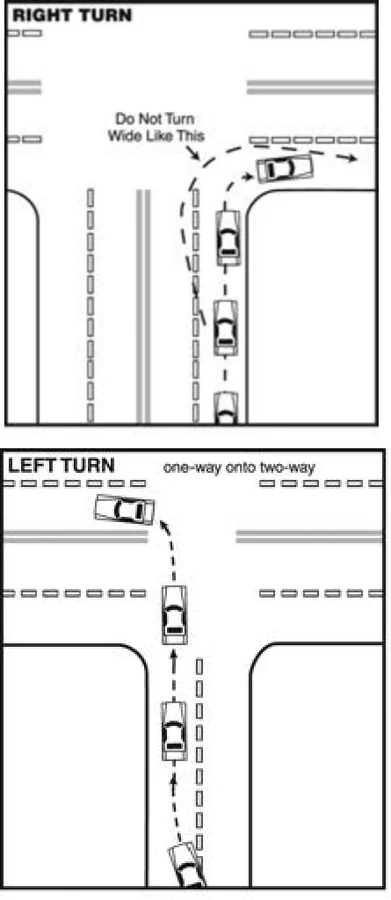
Right turns: don't swing wide to the left. A driver behind may think you're turning left and pass on your right, and drivers in the far lane won't expect you there.

Handbook p. 27 ↗

Know the rule

Left turns: don't cut the corner so sharply that you hit someone approaching from the left, but leave room for oncoming vehicles to turn left in front of you.

Handbook p. 27 ↗

Left turns by street type

Left turns by street type
TurningHow to do it
One-way onto two-wayStart in left lane; enter right of the yellow line
Two-way onto one-wayLeft wheel near yellow line; enter a free lane
Two-way onto two-wayLeft wheels near yellow line; enter right of center
Handbook p. 27 ↗

Know the rule

When your turn takes you onto a four-lane road, you may enter its right lane if that lane is free of traffic.

Handbook p. 27 ↗
Right and left turn lane positioning (one-way/two-way)
Right turn: don't swing wide. Left turn from a one-way street onto a two-way street.

Never make a U-turn:

  • On a curve or near a hill crest where other drivers may not see you
  • Where a "No U-Turn" sign is posted
  • At an intersection controlled by a traffic signal or a police officer
Handbook p. 27 ↗

Know the rule

Make a U-turn only when it is safe. Some towns and cities do not allow U-turns.

Handbook p. 27 ↗

Put it into practice

You're on a two-way street turning left onto a two-lane one-way street. Start with your left wheel as close as possible to the yellow dividing line, then turn into whichever lane is free of traffic.

Check your understanding

Read the question, decide on an answer, then open it to check the explanation. These are Roadwise study questions based on the source handbook.

How far before you turn should you signal, according to the handbook?
  1. At least 50 feet
  2. At least 200 feet
  3. At least 100 feet
  4. At least 500 feet

Answer: At least 100 feet

You should signal at least 100 feet before you turn so other drivers have time to react.

Handbook p. 26 ↗
You are on a two-lane one-way street and want to turn left onto a two-way street. Which lane should you begin your turn in?
  1. The right lane
  2. Either lane, it does not matter
  3. Whichever lane has less traffic
  4. The left lane

Answer: The left lane

Beginning a turn from a one-way street onto a two-way street should start in the left lane.

Handbook p. 27 ↗
When is it acceptable to make a U-turn?
  1. Near a hilltop if no one is coming
  2. When safe and not prohibited
  3. Any time you miss your turn
  4. Only at traffic-signal-controlled intersections

Answer: When safe and not prohibited

You should only make a U-turn when it is safe; some intersections and curves prohibit them.

Handbook p. 27 ↗
Where is a U-turn specifically never allowed, according to the handbook?
  1. On a straight two-lane road
  2. On a residential street
  3. At a four-way stop intersection
  4. At an intersection controlled by a signal or officer

Answer: At an intersection controlled by a signal or officer

Never make a U-turn where marked with a 'No U-Turn' sign or at an intersection controlled by a traffic signal or police officer.

Handbook p. 27 ↗
When making a right turn, what mistake should you avoid to prevent another driver from passing you on the right?
  1. Turning too sharply
  2. Signaling too early
  3. Braking before the turn
  4. Swinging wide first

Answer: Swinging wide first

Swinging wide to the left before a right turn can make the driver behind think you're changing lanes or turning left, and they may try to pass on the right.

Handbook p. 27 ↗
If there are no signs or lane markings controlling a turn, you should turn from the lane closest to the direction you want to go.
  1. True
  2. False

Answer: True

Without controlling signs or markings, turn from the lane closest to your intended direction, crossing the fewest lanes possible.

Handbook p. 26 ↗
Take the lesson checkpoint in the app

More in Rules of the Road