roadwise.Open study app

Missouri driving lesson · Sharing the Road

Sharing the road with large trucks

A 3-minute lesson from the Missouri course. Read the rules and examples, follow the handbook page references, and check your understanding before you move on.

Read time
3 minutes
Course unit
Sharing the Road
Checkpoint questions
6
Source pages
30, 31, 32

Trucks are not large cars. A loaded tractor-trailer can weigh 80,000 pounds, accelerates slowly, needs much more room to stop and has large blind spots. Give trucks space, and never cut one off.

Tractor-trailer facts

Tractor-trailer facts
FactNumber
Typical loaded tractor-trailer weightUp to 80,000 pounds
Total length of the combinationMay exceed 90 feet
Double or triple trailersSometimes over 100 feet
Gears to reach the speed limitMay be ten
Weight moved vs. a car engine30 or 40 times more
Handbook p. 31 ↗

Stopping from 55 mph

Stopping from 55 mph
VehicleDistance to stop
Average passenger carAbout 130–140 feet
Fully loaded tractor-trailerAlmost 400 feet
Handbook p. 31 ↗

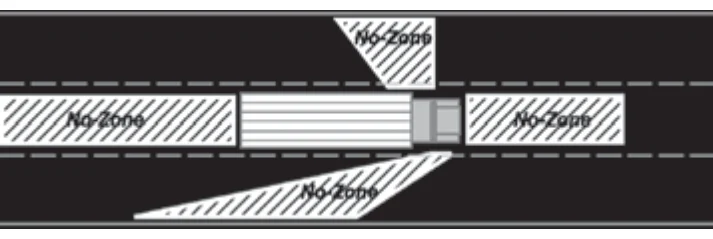
No-Zone

The blind spots on each side, in the rear and in front of a truck or bus where a car can't be seen. Don't drive there except when absolutely necessary.

Handbook p. 31 ↗
Roundabout truck apron diagram
The No-Zone: blind spots around a tractor-trailer

Know the rule

If you're behind a truck or bus and can't see its driver in the rearview mirrors, the driver can't see you.

Handbook p. 31 ↗

Know the rule

Don't drive alongside large vehicles for long periods, and don't tailgate them. Leave a cushion of safety.

Handbook p. 31 ↗

Know the rule

It takes longer to pass a truck. After passing, don't re-enter the lane until you can see the truck's cab in your rearview mirror. Keep your speed, signal, and don't slow down in front of it.

Handbook p. 31 ↗

More rules around trucks:

  • Don't enter the road in front of a large vehicle, or change lanes in front of one when you're turning off
  • On steep grades on divided or multi-lane roads, avoid the right lane where trucks drive slowly
  • Near weigh stations, stay out of the right lane so slow trucks can merge back
  • Vehicles carrying hazardous materials must stop at all railroad crossings; be prepared
  • Trucks may swing left first to make a right turn; watch their turn signals before passing
Handbook p. 31 ↗

Know the rule

Need to turn or change lanes near a truck? Slow down and go behind it. It only takes a few extra seconds.

Handbook p. 31 ↗

Know the rule

Because of its size, a tractor-trailer often looks slower than it really is. Many car-truck crashes happen at intersections when drivers misjudge how close or fast a truck is.

Handbook p. 32 ↗

Put it into practice

A tractor-trailer ahead signals a right turn but drifts left. Don't try to pass on the right: it's swinging wide to make the turn. Stay behind it until the turn is complete.

Check your understanding

Read the question, decide on an answer, then open it to check the explanation. These are Roadwise study questions based on the source handbook.

What is the informal term for the blind spots around a truck or bus where an automobile cannot be seen?
  1. The Danger Ring
  2. The Blind Belt
  3. The Shadow Zone
  4. The No-Zone

Answer: The No-Zone

The blind spots on the sides, rear, and front of large trucks and buses are called the 'No-Zone.'
Handbook p. 31 ↗
If you cannot see a truck driver in their side mirrors, what does that mean?
  1. The truck driver cannot see you either
  2. You are far enough back to be seen
  3. You are in the driver's direct view
  4. The truck is about to change lanes

Answer: The truck driver cannot see you either

If you are driving behind a truck or bus and cannot see the driver in their rearview mirrors, that driver cannot see you.

Handbook p. 31 ↗
At about 55 mph, roughly how far does it take a fully loaded tractor-trailer to come to a complete stop?
  1. About 130-140 feet
  2. Almost 400 feet
  3. About 200 feet
  4. About 1,000 feet

Answer: Almost 400 feet

A fully loaded tractor-trailer may take almost 400 feet to stop, compared to about 130-140 feet for a passenger car at 55 mph.

Handbook p. 31 ↗
What should you do after passing a large truck before returning to your lane?
  1. Slow down once you are in front of it
  2. Merge back as soon as you pass the cab
  3. Wait until you are one car length ahead
  4. See the truck's cab in your rearview mirror

Answer: See the truck's cab in your rearview mirror

After passing, make sure you can see the cab of the truck in your rearview mirror before reentering the lane, and maintain your speed.

Handbook p. 31 ↗
A tractor-trailer ahead of you swings out to the left as it nears an intersection. What may it be about to do?
  1. Make a right turn
  2. Make a left turn
  3. Pull over and park
  4. Stop for a railroad crossing

Answer: Make a right turn

Because of their size, large trucks may swing out to the left as the first step in making a right turn, so watch their signals before passing.

Handbook p. 31 ↗
A typical loaded tractor-trailer combination may weigh up to 80,000 pounds.
  1. True
  2. False

Answer: True

A typical tractor-trailer combination may weigh up to 80,000 pounds.

Handbook p. 31 ↗
Take the lesson checkpoint in the app

More in Sharing the Road