roadwise.Open study app

Mississippi driving lesson · Pavement Markings & Lane Use

Choosing your lane

A 3-minute lesson from the Mississippi course. Read the rules and examples, follow the handbook page references, and check your understanding before you move on.

Read time
3 minutes
Course unit
Pavement Markings & Lane Use
Checkpoint questions
6
Source pages
45, 46

You're always in a lane, marked or not. A road's lane count equals how many cars could travel on it side by side. When your direction has more than one lane, the right lane is home base; the others are for passing and left turns.

Know the rule

On a street or highway with more than one lane in your direction, drive in the extreme RIGHT lane except to pass or turn left.

Handbook p. 45 ↗

Know the rule

If there's no designated turn lane, use the lane next to the center for turning left.

Handbook p. 45 ↗

Know the rule

Lanes exist whether or not they're marked. A one-lane road has room for one car side by side, a two-lane road for two, a three-lane road for three, a four-lane road for four.

Handbook p. 45 ↗

Know the rule

Lanes going in opposite directions are separated by pavement markings (lines), barricades or medians. Some travel lanes have parking lanes next to them.

Handbook p. 45 ↗

Know the rule

NEVER cross a double yellow line, not even to pass a slow-moving car. You'd be driving into oncoming traffic.

Handbook p. 45 ↗

Know the rule

You may cross a single broken yellow line to pass if the oncoming lane is clear and it's safe. With one solid and one broken yellow line, you may cross only if the broken line is closest to your lane.

Handbook p. 45 ↗

Know the rule

Always drive in a single lane, and never change lanes unless the move can be made safely.

Handbook p. 45 ↗
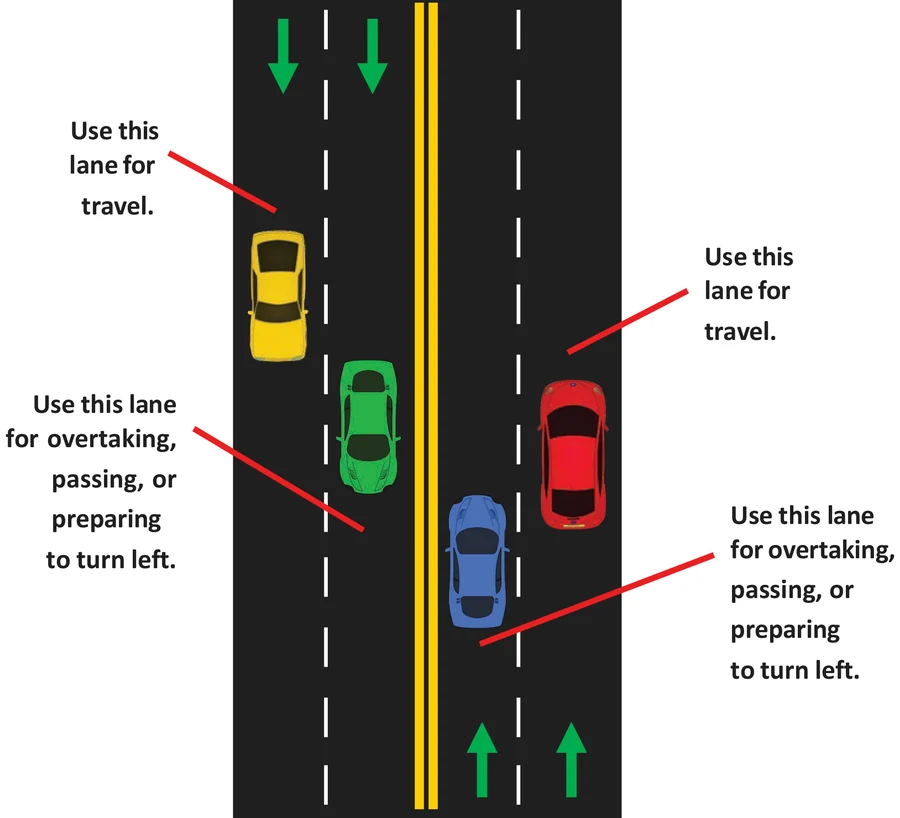
Lane use for four-plus lane roads
Four lanes or more: travel in the right lane; overtake, pass or prepare to turn left from the left lane
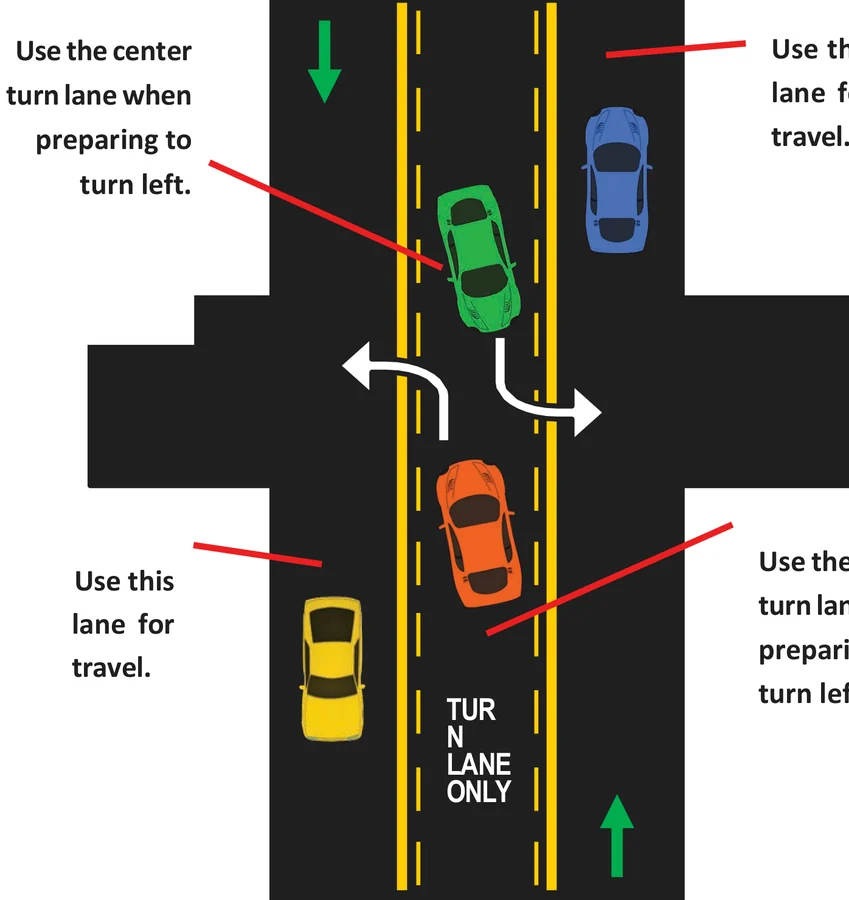
Two lanes plus center turn lane use
Two lanes plus a center turn lane: use the center lane only to prepare to turn left

Lane use at a glance:

  • Four lanes or more: use the right lane for travel
  • Four lanes or more: use the left lane for overtaking, passing or preparing to turn left
  • Two lanes plus center turn lane: use the outer lanes for travel
  • Two lanes plus center turn lane: use the center lane when preparing to turn left
Handbook p. 46 ↗

Put it into practice

On a four-lane highway you're cruising in the left lane with no one to pass and no turn coming up. Move back to the right lane: the left lane is for passing or preparing to turn left.

Check your understanding

Read the question, decide on an answer, then open it to check the explanation. These are Roadwise study questions based on the source handbook.

On a multi-lane highway, which lane should you generally drive in?
  1. The extreme left lane, except to pass or turn right
  2. The extreme right lane, except to pass or turn left
  3. The center lane at all times
  4. Whichever lane has the least traffic

Answer: The extreme right lane, except to pass or turn left

Drivers should stay in the extreme right lane except when passing or turning left.
Handbook p. 45 ↗
If there's no designated turn lane, which lane should you use to prepare for a left turn?
  1. The extreme right lane
  2. Any lane, since none is designated
  3. The shoulder
  4. The lane next to the center

Answer: The lane next to the center

Without a designated turn lane, use the lane next to the center for turning left.

Handbook p. 45 ↗
On a highway divided by both a solid yellow line and a broken yellow line, when may you cross to pass?
  1. Only when the broken line is on your side and it's clear
  2. Anytime the oncoming lane looks clear
  3. Only during daylight hours
  4. Never, regardless of which line is closest

Answer: Only when the broken line is on your side and it's clear

You may cross this line pair for passing only when the broken yellow line is on your side and it is safe to pass.

Handbook p. 45 ↗
How many cars can generally travel side-by-side on a four-lane street or highway?
  1. Three
  2. Four
  3. Two
  4. Six

Answer: Four

A street or highway's number of lanes corresponds to the number of cars that can travel side-by-side, so a four-lane road fits four.

Handbook p. 45 ↗
What separates opposite-direction lanes if there is no painted center line?
  1. Only the presence of a shoulder
  2. Nothing; opposite lanes are never separated without a painted line
  3. Only traffic signs, never physical barriers
  4. Barricades or medians may separate them instead

Answer: Barricades or medians may separate them instead

Opposite-direction lanes may be separated by pavement markings, barricades, or medians.

Handbook p. 45 ↗
A road's traffic lanes exist and must be respected even when they are not marked with painted lines.
  1. True
  2. False

Answer: True

Lanes may or may not be marked, but they exist just the same and must be observed.

Handbook p. 45 ↗
Take the lesson checkpoint in the app

More in Pavement Markings & Lane Use