roadwise.Open study app

Mississippi driving lesson · Pavement Markings & Lane Use

Center lines & lane lines

A 3-minute lesson from the Mississippi course. Read the rules and examples, follow the handbook page references, and check your understanding before you move on.

Read time
3 minutes
Course unit
Pavement Markings & Lane Use
Checkpoint questions
6
Source pages
25

Pavement markings are rules painted on the road, and you must obey them. Color tells you direction: yellow lines separate traffic going opposite ways; white lines separate lanes going the same way. A solid line says stay put; a broken line says you may cross when it's safe.

Know the rule

Main highways are marked with center lines, lane lines and directional arrows. You must observe and comply with these markings.

Handbook p. 25 ↗
Broken white line (lane changing allowed)
Broken yellow line

Know the rule

A broken yellow line separates lanes moving in opposite directions. You may cross into the oncoming lane ONLY to pass, and only when it's safe to pass.

Handbook p. 25 ↗
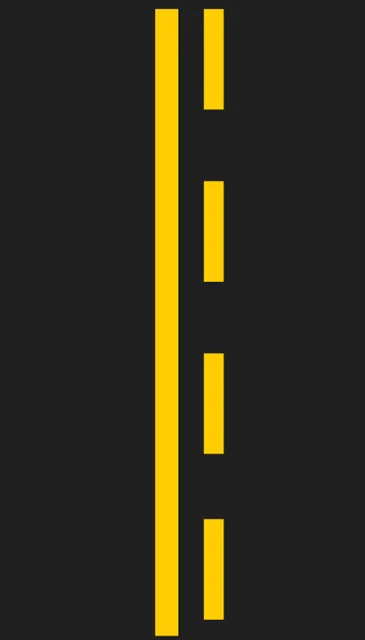
Solid and broken yellow lines
Broken yellow line next to a solid yellow line

Know the rule

A broken yellow line next to a solid yellow line: if the broken line is closest to your lane, you may pass with caution. If the solid line is closest to your lane, passing is forbidden.

Handbook p. 25 ↗
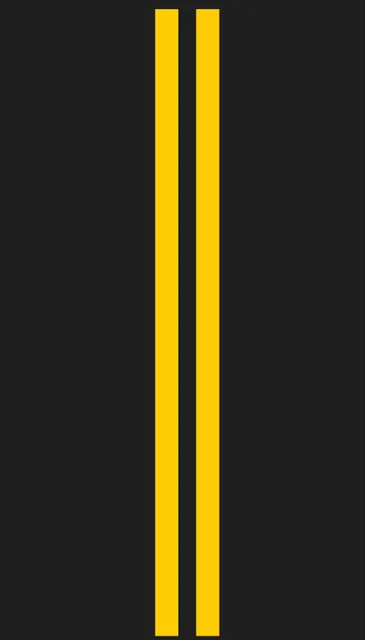
Double solid yellow lines
Double solid yellow line

Know the rule

A double solid yellow line separates lanes moving in opposite directions. Passing from either side of it is PROHIBITED.

Handbook p. 25 ↗
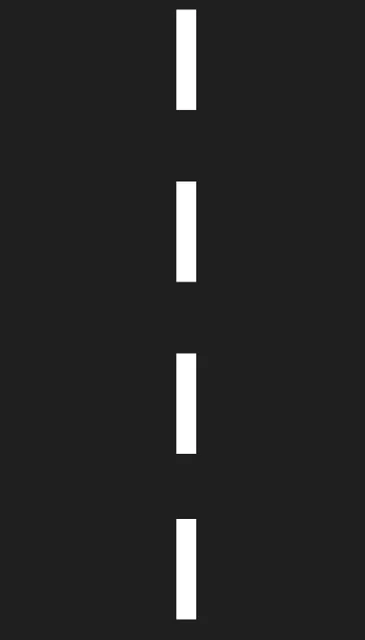
Broken white line (lane changing allowed)
Broken white line

White lines (same-direction traffic on both sides)

White lines (same-direction traffic on both sides)
MarkingCrossing it
Broken whiteAllowed, to change lanes when safe
Single solid whiteDiscouraged
Double solid whitePROHIBITED
Handbook p. 25 ↗
Solid white line
Single solid white line (top) and double solid white line (bottom)

Put it into practice

You're on a two-lane road behind a slow tractor. The center line is solid yellow on your side and broken yellow on the far side. You may not pass. Wait until the broken line is on your side and the oncoming lane is clear.

Check your understanding

Read the question, decide on an answer, then open it to check the explanation. These are Roadwise study questions based on the source handbook.

You are on a two-lane road with a solid yellow line nearest your lane and a broken yellow line on the other side. May you pass?
  1. No, passing is forbidden
  2. Yes, if the vehicle ahead is under the speed limit
  3. Yes, if no other cars are visible
  4. Yes, because a broken line exists somewhere in the pair

Answer: No, passing is forbidden

When the solid line is closest to your lane, passing is forbidden even though the far side has a broken line.
Handbook p. 25 ↗
What does a single broken white line mean?
  1. Travel in the same direction is permitted on both sides
  2. You must turn at the next intersection
  3. The lane ahead is closed
  4. Opposite-direction traffic is separated and passing is never allowed

Answer: Travel in the same direction is permitted on both sides

A broken white line separates same-direction lanes; crossing it to change lanes is allowed when safe.

Handbook p. 25 ↗
What does a double solid yellow line mean for passing?
  1. You may pass only on a two-lane road
  2. Crossing it to pass is prohibited
  3. You may pass if your lane has no oncoming traffic
  4. You may pass with caution during daylight only

Answer: Crossing it to pass is prohibited

A double solid yellow line separates opposite-direction lanes, and crossing it is prohibited.

Handbook p. 25 ↗
What is the rule for crossing a double solid white line to change lanes?
  1. It is prohibited
  2. It is allowed only on interstates
  3. It is allowed if traffic is light
  4. It is allowed if you signal first

Answer: It is prohibited

A double solid white line permits same-direction travel on both sides, but crossing it is prohibited.

Handbook p. 25 ↗
A vehicle is traveling alongside a solid white line with same-direction traffic on both sides. Is crossing that line to change lanes prohibited?
  1. Yes, unless you signal first
  2. No, but it is discouraged
  3. Yes, it is always prohibited
  4. Yes, unless traveling over 45 mph

Answer: No, but it is discouraged

A single solid white line permits travel on both sides; crossing it is discouraged, not prohibited.

Handbook p. 25 ↗
You may cross a single, solid white line to change lanes, although the handbook discourages it.
  1. True
  2. False

Answer: True

A single solid white line permits same-direction travel on both sides; crossing it is discouraged but not prohibited.

Handbook p. 25 ↗
Take the lesson checkpoint in the app

More in Pavement Markings & Lane Use