A 3-minute lesson from the Minnesota course. Read the rules and examples, follow the handbook page references, and check your understanding before you move on.
Before you drive on public roads, your vehicle must be fully equipped and working. Read the owner's manual, check the lights, wipers, horn and tires regularly, and adjust your seat and mirrors every time you get in.
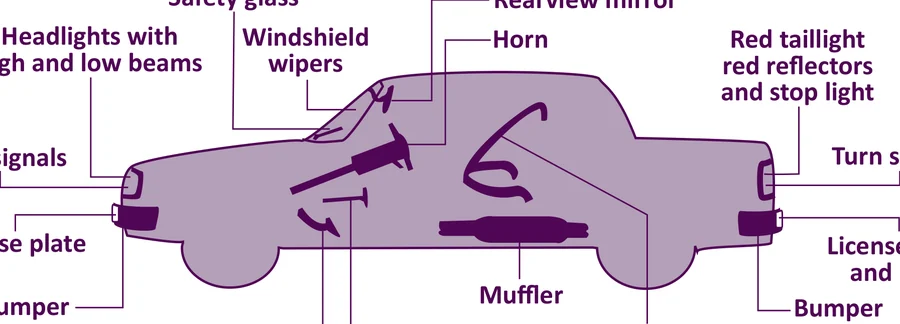
Required equipment on a passenger vehicle
Know the rule
All cars and trucks must have at least two separate brake systems, such as the foot brake and the parking/emergency brake.
Your vehicle must have a working horn. Bells, sirens and whistles are not horns and may be used only by emergency vehicles. Use the horn to avoid a crash — not to honk needlessly or announce your arrival.
Daytime running lights don't turn on your taillights or parking lights. Use headlights from sunset to sunrise, in rain, snow, hail, sleet or fog, and any time you can't see the road ahead for at least 500 feet.
Every motor vehicle needs a muffler to prevent sudden or prolonged loud noise, especially popping or crackling. Check it regularly for carbon monoxide leaks.
All vehicles in Minnesota must have seat belts and everyone must use them. Airbags work with seat belts but don't stop occupants from being ejected. Keep the dashboard clear — objects become dangerous if airbags inflate.
At 3 p.m., fog cuts your view to about 400 feet. Your daytime running lights are on, but that isn't enough: switch on your headlights, because you can't see 500 feet ahead — and running lights leave your taillights dark.
Check your understanding
Read the question, decide on an answer, then open it to check the explanation. These are Roadwise study questions based on the source handbook.
How many separate brake systems must a car or truck have?
At least three
Only one
At least two
Exactly four
Answer: At least two
All cars and trucks must have at least two separate brake systems, such as the foot brake and parking brake.