roadwise.Open study app

Minnesota driving lesson · Driving Conditions

Entering and driving on the freeway

A 3-minute lesson from the Minnesota course. Read the rules and examples, follow the handbook page references, and check your understanding before you move on.

Read time
3 minutes
Course unit
Driving Conditions
Checkpoint questions
6
Source pages
77, 78

Freeways are multi-lane, divided highways with limited access and no stops or cross traffic. The skills that matter are merging smoothly and choosing the right lane.

Acceleration lane

The lane at the end of most entry ramps that lets you speed up to match freeway traffic before merging.

Handbook p. 77 ↗

Merging onto a freeway

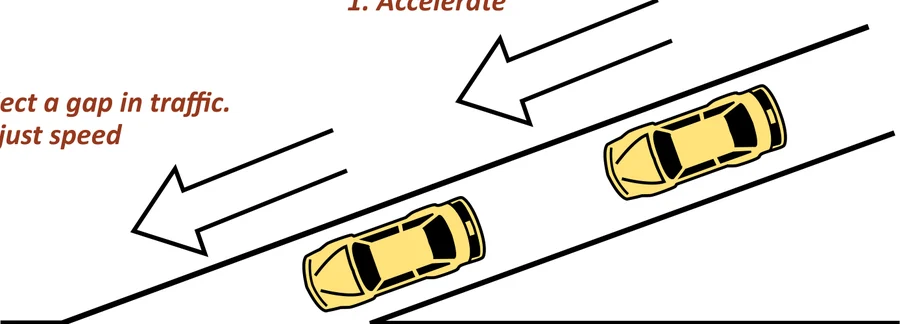
  • Accelerate to match the speed of vehicles already on the freeway
  • Signal your intention
  • Watch for an opening in the nearest lane
  • Yield to vehicles already on the freeway
  • Merge into the flow when you can do so safely
Handbook p. 77 ↗
Freeway entrance merge (select a gap)
Merging: accelerate, pick a gap, signal and move in

Know the rule

Don't stop on the ramp or in the acceleration lane unless absolutely necessary. With no acceleration lane and a Yield sign on the ramp, obey the sign, stop if necessary and don't force your way in.

Handbook p. 77 ↗

Know the rule

Ramp meters sit about halfway down many metro entry ramps and usually run in peak hours to reduce jams and crashes. Going through the red is illegal, and only one car may go on each green.

Handbook p. 77 ↗

Know the rule

Keep about the same speed as surrounding traffic without exceeding the limit. If you're slower than others, use the lane nearest the right side. To pass or exit, signal and make sure your path is clear.

Handbook p. 77 ↗

Buses on freeway shoulders

Buses on freeway shoulders
RuleLimit
Who may use the shoulderTransit and metro mobility buses
Allowed only when mainline traffic isSlower than 35 mph
Max speed over mainline traffic15 mph
Absolute speed cap on the shoulder35 mph
Handbook p. 78 ↗

Know the rule

Buses on the shoulder must yield to merging, entering and exiting traffic and to other vehicles on the shoulder.

Handbook p. 78 ↗

Know the rule

Freeway message signs warn of crashes, stalled vehicles and other conditions. During an AMBER Alert they may describe a vehicle; if you see it or know about the missing child, notify law enforcement.

Handbook p. 78 ↗

Know the rule

High-occupancy vehicle (HOV) lanes are only for motorcycles, buses and vehicles carrying two or more people.

Handbook p. 78 ↗

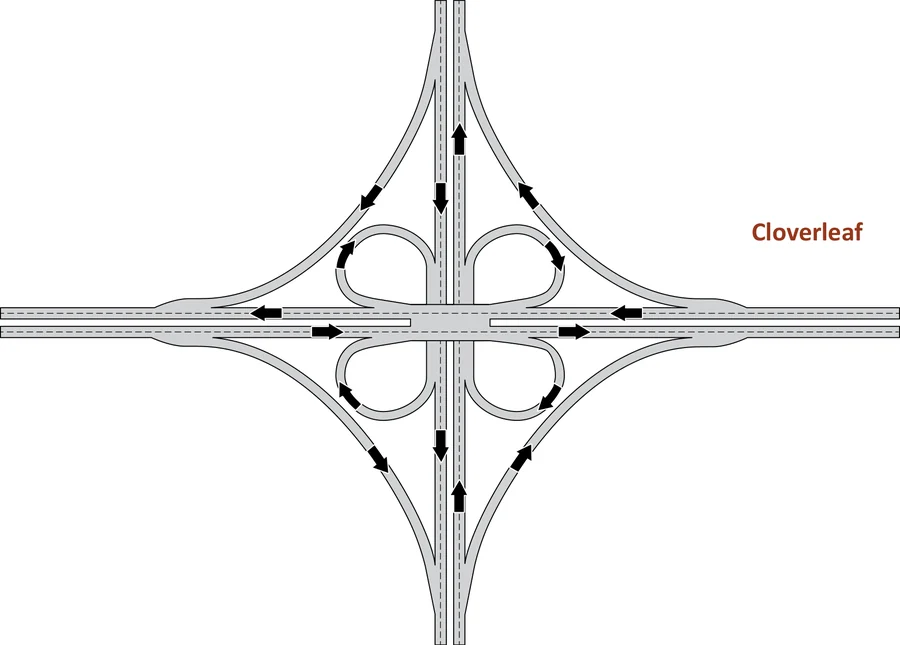
Interchange

A series of ramps connecting a freeway to a road or another freeway, letting you change roads without disrupting traffic flow.

Handbook p. 78 ↗
Cloverleaf interchange diagram
Cloverleaf interchange

Put it into practice

The ramp meter is red. Stop at the line; when it turns green, only your car goes. Then use the acceleration lane to reach freeway speed, signal and merge into a gap — yielding to traffic already there.

Check your understanding

Read the question, decide on an answer, then open it to check the explanation. These are Roadwise study questions based on the source handbook.

What is the purpose of an acceleration lane at a freeway entrance?
  1. To let slower vehicles exit
  2. To provide emergency parking
  3. To wait for a gap before merging
  4. To build up speed to merge safely

Answer: To build up speed to merge safely

Acceleration lanes let entering drivers match freeway speed before merging.
Handbook p. 77 ↗
When merging onto a freeway, who must yield?
  1. You, the entering driver
  2. Freeway traffic in the right lane
  3. Whoever is going faster
  4. The driver who signals first

Answer: You, the entering driver

Entering drivers must yield to traffic already flowing on the freeway.

Handbook p. 77 ↗
Freeway ramp meters are traffic signals typically placed where on the entry ramp?
  1. At the very start of the ramp
  2. About halfway down the ramp
  3. At the very end of the ramp
  4. Only at the freeway merge point

Answer: About halfway down the ramp

Ramp meters are usually placed about halfway down the entry ramp.

Handbook p. 77 ↗
If you are driving slower than surrounding freeway traffic, which lane should you use?
  1. The far left lane
  2. The lane with the least traffic
  3. The lane nearest the right side of the road
  4. The center lane only

Answer: The lane nearest the right side of the road

Slower drivers should stay in the lane nearest the right side of the freeway.

Handbook p. 77 ↗
Transit and metro mobility buses may use a freeway shoulder only when mainline traffic speed is below what?
  1. 55 mph
  2. 20 mph
  3. 45 mph
  4. 35 mph

Answer: 35 mph

Buses can only use the shoulder when mainline traffic is moving slower than 35 mph.

Handbook p. 78 ↗
HOV lanes on a freeway are reserved for which vehicles?
  1. Buses and vehicles with 3+ occupants
  2. Motorcycles, buses, and 2+ occupant vehicles
  3. Buses, taxis, and commercial trucks
  4. Buses and vanpools of 7 or more

Answer: Motorcycles, buses, and 2+ occupant vehicles

HOV lanes are limited to motorcycles, buses, and vehicles with two or more occupants.

Handbook p. 78 ↗
Take the lesson checkpoint in the app

More in Driving Conditions