roadwise.Open study app

Iowa driving lesson · Intersections, Interchanges & Roundabouts

Rural four-lane crossings and on-ramps

A 2-minute lesson from the Iowa course. Read the rules and examples, follow the handbook page references, and check your understanding before you move on.

Read time
2 minutes
Course unit
Intersections, Interchanges & Roundabouts
Checkpoint questions
6
Source pages
51

On a rural four-lane divided highway, traffic moves very fast. Don't try to cross both directions at once—use the median as a halfway stop. Entering an interstate is the opposite problem: you need to get up to speed before you merge.

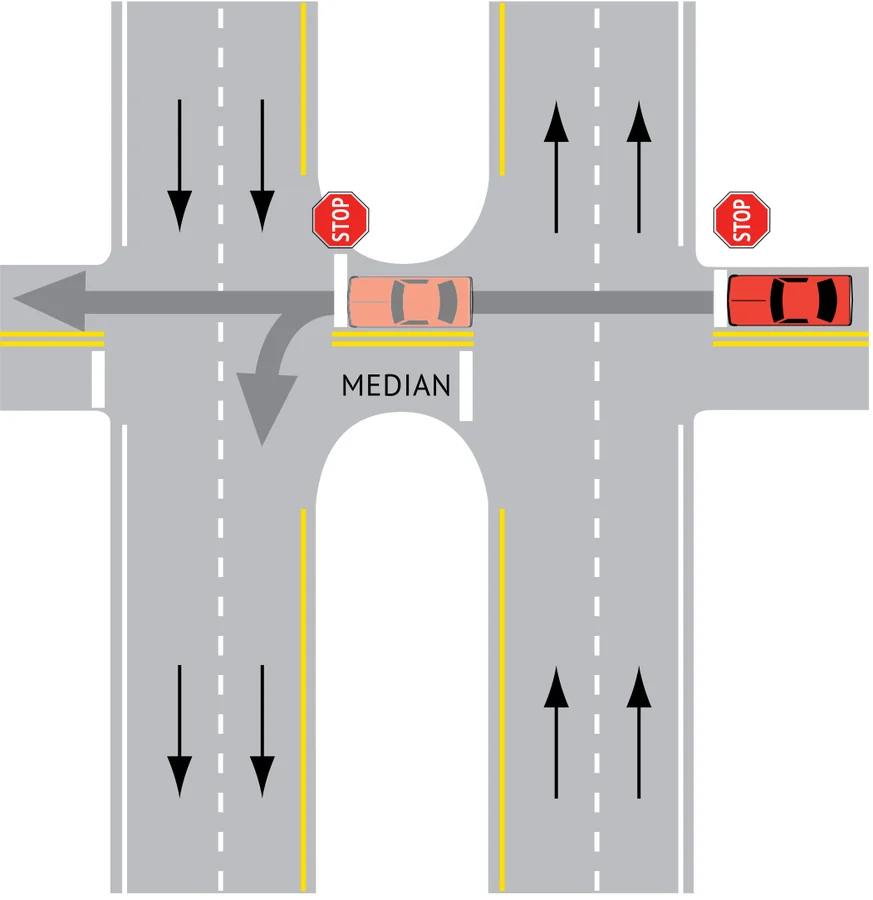
Crossing or turning left onto a rural four-lane road:

  • 1. Stop at the stop sign, look left, and proceed into the median when safe
  • 2. Remain stopped in the median, look right, then cross or turn left when safe
Handbook p. 51 ↗

Know the rule

Don't try to cross both directions of traffic at one time just to avoid stopping in the median.

Handbook p. 51 ↗

Know the rule

Longer vehicles, such as semis, may not be able to stop in the median if it is narrow.

Handbook p. 51 ↗
Crossing a rural four-lane highway using the median
Crossing a rural four-lane road in two stages

On-ramp segments (Figure 5.2)

On-ramp segments (Figure 5.2)
SegmentWhat happens there
1. Entrance areaScan; judge the space and speed you need to enter
2. Acceleration and merge areaReach traffic speed; merge when safe
3. Travel portion of interstateTraffic moves over, slows, or speeds up
Handbook p. 51 ↗

Know the rule

Do not completely stop on the ramp unless absolutely necessary.

Handbook p. 51 ↗

Know the rule

Traffic already on an interstate or highway should move over, slow down, or speed up to allow ramp traffic to enter.

Handbook p. 51 ↗

Put it into practice

Entering I-80, use the entrance area to spot a gap, speed up in the acceleration area to match traffic, signal, and merge. Don't stop at the end of the ramp unless you absolutely must.

Check your understanding

Read the question, decide on an answer, then open it to check the explanation. These are Roadwise study questions based on the source handbook.

Crossing a rural four-lane road from a stop sign, what should you do after stopping and looking left?
  1. Cross both directions in one motion
  2. Enter the median, stop, then look right
  3. Look right, then cross both directions
  4. Enter the median, then keep going

Answer: Enter the median, stop, then look right

The manual describes a two-step process: cross into the median first, then stop, look right, and cross or turn when safe.
Handbook p. 51 ↗
What is the purpose of an on-ramp's acceleration and merge area?
  1. To stop and wait for a gap
  2. To scan the road and judge space
  3. To match traffic speed before merging
  4. To slow down before the interstate

Answer: To match traffic speed before merging

The acceleration and merge area is used to match the speed of traffic and merge when safe.

Handbook p. 51 ↗
Why is extra caution needed for long vehicles like semis crossing a rural four-lane median?
  1. Semis must always yield to smaller vehicles there
  2. Long vehicles automatically get priority
  3. Semis are not allowed to turn left there
  4. The median may be too narrow for them

Answer: The median may be too narrow for them

Longer vehicles like semis may not be able to stop in a narrow median, requiring extra caution.

Handbook p. 51 ↗
What should you evaluate during the entrance area of an on-ramp?
  1. Where to stop and wait for a gap
  2. The space and speed needed to enter
  3. The ramp's speed limit only
  4. Which lane to use on the interstate

Answer: The space and speed needed to enter

The entrance area gives you time to scan the roadway and evaluate space and speed needed.

Handbook p. 51 ↗
How should existing interstate traffic respond to vehicles entering from a ramp?
  1. Move over or adjust speed for them
  2. Hold speed; ramp traffic must yield
  3. Stop to let them in
  4. Move to the shoulder for them

Answer: Move over or adjust speed for them

Traffic already on the interstate should adjust to allow ramp traffic to enter safely.

Handbook p. 51 ↗
You should avoid stopping completely on an on-ramp unless it's absolutely necessary.
  1. True
  2. False

Answer: True

The manual advises not to completely stop on the ramp unless absolutely necessary.

Handbook p. 51 ↗
Take the lesson checkpoint in the app

More in Intersections, Interchanges & Roundabouts