Reduced-conflict intersections and diverging diamonds
A 2-minute lesson from the Iowa course. Read the rules and examples, follow the handbook page references, and check your understanding before you move on.
Iowa uses newer intersection designs to cut crashes and delays. They look unusual the first time, but each follows one simple idea.
Reduced-conflict intersection
Designed to reduce the number of points where vehicles can crash. Side-road drivers turning left or crossing a four-lane highway turn right, merge left, then U-turn at a median opening.
Reduced-conflict intersections improve safety because you deal with only one direction of highway traffic at a time—you don't need a gap in both directions to cross.
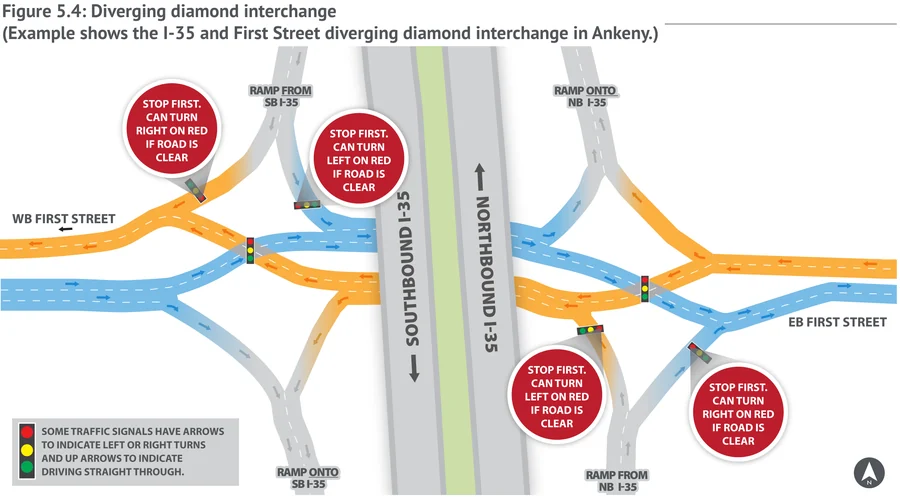
A diverging diamond maximizes efficiency by making traffic spend less time at a traditional traffic-light-controlled intersection. Example: I-35 and First Street in Ankeny.
Diverging diamond interchange (I-35 and First Street, Ankeny)
Put it into practice
From a side road you need to go left onto a four-lane highway with a reduced-conflict design. Instead of waiting for gaps both ways, turn right, merge into the left lane, and U-turn at the median opening.
Check your understanding
Read the question, decide on an answer, then open it to check the explanation. These are Roadwise study questions based on the source handbook.
At a reduced-conflict intersection, how does a driver from the side road turn left across the highway?
Turn right, merge left, then U-turn at the median
Cross both lanes of traffic directly
Wait for a signal that stops highway traffic
Turn left into the median and wait
Answer: Turn right, merge left, then U-turn at the median
Reduced-conflict intersections require drivers to turn right, merge left, then U-turn at a designated median opening.