roadwise.Open study app

Iowa driving lesson · Turning, Lane Changes & Passing

Passing safely

A 3-minute lesson from the Iowa course. Read the rules and examples, follow the handbook page references, and check your understanding before you move on.

Read time
3 minutes
Course unit
Turning, Lane Changes & Passing
Checkpoint questions
6
Source pages
16, 45, 46

Pass only when signs or markings allow it, you have enough room, and passing is actually necessary. Passing puts you in the path of oncoming traffic or beside other vehicles, so it takes planning.

Know the rule

As a rule, pass only one vehicle at a time. Avoid passing where vehicles may enter the road ahead of you, such as intersections and driveways.

Handbook p. 45 ↗

Passing steps:

  • 1. Check the passing lane ahead for plenty of space
  • 2. Check mirrors and blind spots for traffic
  • 3. Signal your intent to pass and accelerate as needed
  • 4. While passing, watch the space ahead and behind, and check the rearview mirror
  • 5. When the passed car's front shows in your mirror, signal, ease back, cancel signal, resume speed
Handbook p. 45 ↗

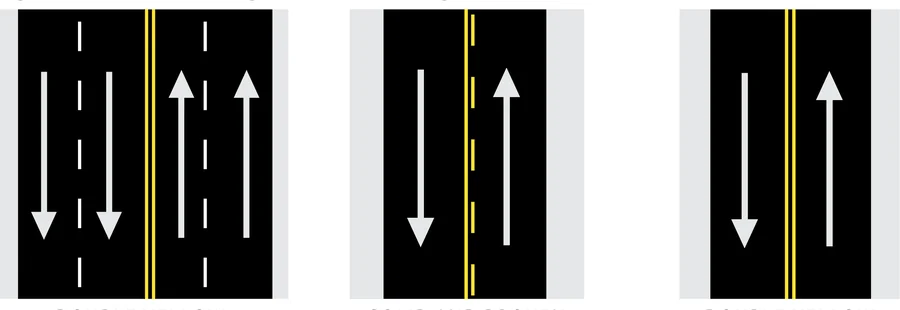
Passing markings (Figure 4.5)

Passing markings (Figure 4.5)
MarkingRule
Double solid yellow center lineNo passing in either lane
Solid and broken yellowDon't pass when the solid line is on your side
White lane linesPass over broken white; never over center yellow
Handbook p. 45 ↗
Center line pavement markings (double yellow variations)
Pavement markings that show passing rules

Never pass (Figure 4.6):

  • When approaching the top of a hill
  • On a curve when your view along the roadway is obstructed
  • Within 100 feet of a signed narrow bridge, viaduct, or tunnel
  • Within 100 feet of a railroad crossing
  • Within 100 feet of an intersection
  • On the right
  • When oncoming traffic is so close it would be dangerous
Handbook p. 46 ↗
100 ft

No passing within this distance of an intersection, railroad crossing, or signed narrow bridge, viaduct, or tunnel

Handbook p. 46 ↗

Know the rule

Never pass on the shoulder, paved or not.

Handbook p. 16 ↗

Put it into practice

On a two-lane highway a broken yellow line is on your side and the road ahead looks clear, but a railroad crossing is 80 feet ahead. Wait—passing within 100 feet of a railroad crossing is illegal.

Check your understanding

Read the question, decide on an answer, then open it to check the explanation. These are Roadwise study questions based on the source handbook.

How close to a marked railroad crossing may you begin passing another vehicle?
  1. You may not pass within 100 feet of it
  2. You may not pass within 20 feet of it
  3. You may not pass within 300 feet of it
  4. There is no restriction near railroad crossings

Answer: You may not pass within 100 feet of it

Passing is prohibited within 100 feet of a railroad crossing.
Handbook p. 46 ↗
On a two-way road, the center markings are a broken yellow line on your side and a solid yellow line on the other side. What does this mean?
  1. Neither direction may pass
  2. You may pass when safe; they may not
  3. Only the other direction may pass
  4. Both directions may pass freely

Answer: You may pass when safe; they may not

Passing is not allowed from the side with the solid yellow line; vehicles on the dashed-line side may pass when safe.

Handbook p. 15 ↗
Why should you avoid passing near the top of a hill?
  1. Passing lanes end at hilltops
  2. Your car slows going uphill
  3. You can't see oncoming traffic in time
  4. Trucks have the right-of-way on hills

Answer: You can't see oncoming traffic in time

Passing areas depend on how far you can see ahead, and approaching a hilltop you can't see oncoming vehicles in time.

Handbook p. 46 ↗
Which of these is NOT one of the 100-foot no-passing zones listed in the manual?
  1. 100 feet from a stop sign
  2. 100 feet from a marked narrow bridge
  3. 100 feet from an intersection
  4. 100 feet from a railroad crossing

Answer: 100 feet from a stop sign

The 100-foot no-passing rule covers railroad crossings, intersections, and marked narrow bridges or tunnels — not stop signs.

Handbook p. 46 ↗
As a rule, you should only pass one vehicle at a time.
  1. True
  2. False

Answer: True

The manual instructs passing only one vehicle at a time as a rule.

Handbook p. 45 ↗
It's acceptable to pass another vehicle on the right if the right lane is open and moving faster.
  1. True
  2. False

Answer: False

The manual lists passing on the right among the situations where passing is not allowed.

Handbook p. 46 ↗
Take the lesson checkpoint in the app

More in Turning, Lane Changes & Passing