roadwise.Open study app

Iowa driving lesson · Speed, Stopping & Following Distance

Following distance and ABS

A 2-minute lesson from the Iowa course. Read the rules and examples, follow the handbook page references, and check your understanding before you move on.

Read time
2 minutes
Course unit
Speed, Stopping & Following Distance
Checkpoint questions
6
Source pages
41

The greatest chance of a collision is in front of you. A safe following distance gives you time to brake to a stop if needed. Measure it in seconds, not car lengths.

Know the rule

Use the 3- to 4-second rule to set and keep a safe following distance. It only works in normal traffic under good weather conditions.

Handbook p. 41 ↗

Following distance

Following distance
SituationKeep at least
Beginning driver, normal conditions3 seconds
Experienced driver, normal conditions2 seconds may be sufficient
Speeds of 40 mph4 to 5 seconds
Slippery roads, or vehicle ahead blocks view6 or more seconds
Handbook p. 41 ↗

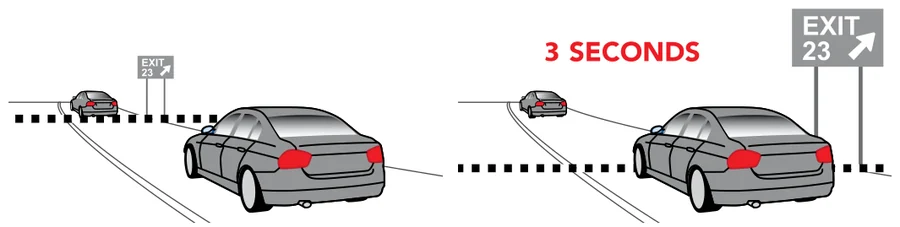
How to count your following distance:

  • Watch the vehicle ahead pass a landmark, such as a sign
  • Begin slowly counting
  • Your front bumper should not pass the landmark before you've counted to three
Handbook p. 41 ↗
3-4 second following distance rule
The 3- to 4-second rule

ABS (antilock braking system)

Found on most newer vehicles; lets you stop without skidding. Read your owner's manual on how to use it.

Handbook p. 41 ↗

Stopping quickly with ABS:

  • Press the brake pedal as hard as you can and keep pressing
  • You may feel the pedal push back while ABS works—don't let up
  • ABS only works with the brake pedal pushed down
Handbook p. 41 ↗

Put it into practice

You're following a box truck that blocks your view on a wet highway, and you count only two seconds past a sign. Drop back until you count six or more.

Check your understanding

Read the question, decide on an answer, then open it to check the explanation. These are Roadwise study questions based on the source handbook.

What following distance does the manual recommend for a beginning driver under normal conditions?
  1. At least 1 second
  2. At least 6 seconds
  3. At least 2 seconds
  4. At least 3 seconds

Answer: At least 3 seconds

An inexperienced or beginning driver should maintain at least a 3-second following distance under normal conditions.
Handbook p. 41 ↗
The road is slippery and the vehicle ahead blocks your view. What following distance is recommended?
  1. Six or more seconds
  2. Two seconds
  3. Three seconds
  4. One second

Answer: Six or more seconds

When road conditions are slippery or the vehicle ahead blocks your view, a following distance of 6 or more seconds is recommended.

Handbook p. 41 ↗
If your vehicle has ABS and you need to stop quickly, what should you do?
  1. Pump the brake pedal repeatedly yourself
  2. Press the brake hard and keep pressing
  3. Let off the brake slightly if you feel pulsing
  4. Shift to neutral before braking

Answer: Press the brake hard and keep pressing

With ABS, press the brake pedal as hard as you can and keep pressing, without letting up even if it pushes back.

Handbook p. 41 ↗
What following distance is recommended at speeds around 40 mph?
  1. 4 to 5 seconds
  2. 1 to 2 seconds
  3. 8 to 10 seconds
  4. 2 to 3 seconds

Answer: 4 to 5 seconds

At 40 mph, the manual recommends a 4- to 5-second following distance.

Handbook p. 41 ↗
The 3- to 4-second rule works reliably under which conditions?
  1. Any weather, including heavy snow
  2. Normal traffic under good weather conditions
  3. Only on the interstate
  4. Only at night

Answer: Normal traffic under good weather conditions

The manual notes this rule only works in normal traffic under good weather conditions.

Handbook p. 41 ↗
An experienced driver may use a 2-second following distance in normal conditions.
  1. True
  2. False

Answer: True

The manual notes a two-second following distance may be sufficient in normal conditions for an experienced driver.

Handbook p. 41 ↗
Take the lesson checkpoint in the app

More in Speed, Stopping & Following Distance