roadwise.Open study app

Iowa driving lesson · Vehicle Readiness

Brakes, lights, windows, and tires

A 4-minute lesson from the Iowa course. Read the rules and examples, follow the handbook page references, and check your understanding before you move on.

Read time
4 minutes
Course unit
Vehicle Readiness
Checkpoint questions
6
Source pages
23, 24

A well-maintained vehicle saves money and gives you an advantage in an emergency. Follow the maintenance schedule in your owner's manual, and know the equipment Iowa requires—several of these numbers appear on the test.

Know the rule

Cars, trucks, and ATVs/UTVs need two separate braking systems: a foot brake and a parking brake. Motorcycles and mopeds need at least one.

Handbook p. 23 ↗

Have a mechanic check your brakes if they:

  • Don't seem to be working properly
  • Make a lot of noise
  • Have an unusual odor
  • Let the brake pedal go to the floor
Handbook p. 23 ↗

Required lights (cars, trucks, ATVs/UTVs):

  • Two headlights on the front: one on the right and one on the left
  • At least one red light on the back, visible for at least 500 feet
  • A white light to illuminate the rear license plate
  • Turn signals that work, if equipped—required on all cars, trucks, and trailers wider than 40 inches
Handbook p. 24 ↗
500 ft

Your rear red light must be visible for at least this distance

Handbook p. 24 ↗
50%

How much dirt on the lenses can cut a light's effectiveness

Handbook p. 24 ↗

Know the rule

Check signals, brake lights, taillights, and headlights from outside the vehicle. If you have trouble seeing at night or other drivers keep flashing their headlights at you, have a mechanic check the headlights—a misaligned one can blind others.

Handbook p. 24 ↗

Windows and glass:

  • Replace damaged or broken windows—they break more easily and can obscure vision
  • Keep the windshield clean; sun or headlights on a dirty windshield make it hard to see
  • Keep washer fluid full; use antifreeze wash when it could fall below freezing
  • Clear snow, ice, or frost from front, side, and back windows before you drive
  • Windshield wipers are required—replace blades that don't keep the windshield clean
  • Don't hang things from the rearview mirror or clutter the windshield with decals
Handbook p. 24 ↗
70%

Tinted windshields and windows right or left of the driver must let at least this much light through

Handbook p. 24 ↗

Know the rule

Iowa does not have a medical exemption for tinted windows.

Handbook p. 24 ↗

Know the rule

Worn, bald, or unbalanced tires can increase stopping distance, cause hydroplaning, wear faster, reduce fuel economy, and make the vehicle harder to steer and stop.

Handbook p. 24 ↗

Know the rule

If the vehicle bounces, the steering wheel shakes, or the vehicle pulls to one side, have a mechanic check it.

Handbook p. 24 ↗

Know the rule

Keep tires properly inflated—check with an air pressure gauge. The correct pressure is commonly listed on a sticker inside the driver's door or in the owner's manual.

Handbook p. 24 ↗

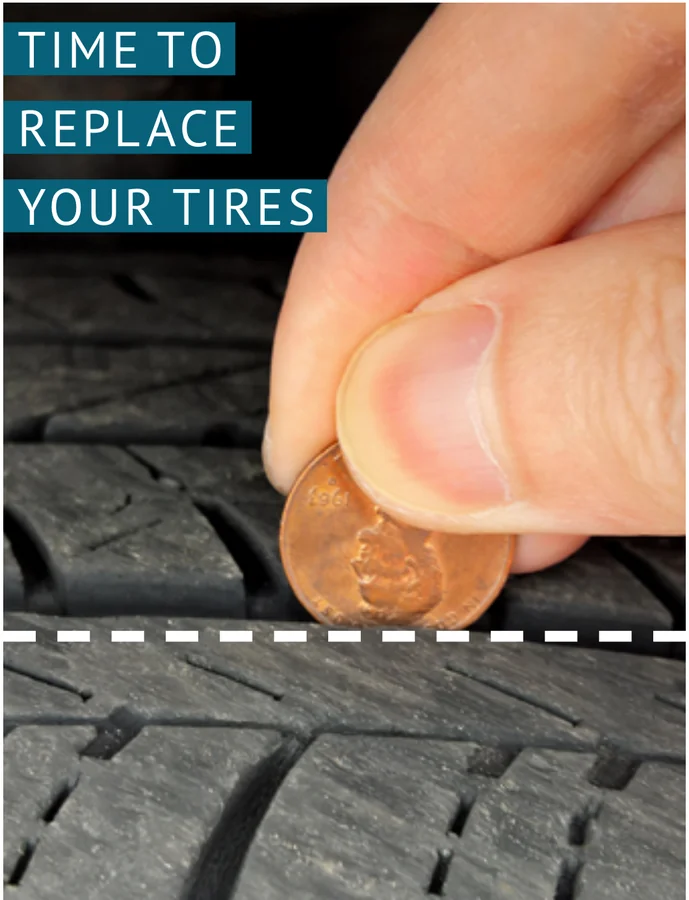
Penny test

Stick a penny into the tread, Lincoln's head first. If the tread doesn't reach at least the top of Lincoln's head, the tire is unsafe and should be replaced.

Handbook p. 24 ↗
Penny tire tread test
Checking tire tread with a penny

Put it into practice

Your car pulls to the right and the steering wheel shakes at highway speed. Those are tire or balance warning signs—have a mechanic check it before your next long drive.

Check your understanding

Read the question, decide on an answer, then open it to check the explanation. These are Roadwise study questions based on the source handbook.

Your vehicle's rear red light must be visible from at least how far away?
  1. At least 100 feet
  2. At least 500 feet
  3. At least 1,000 feet
  4. At least 50 feet

Answer: At least 500 feet

You need at least one red light on the back of the vehicle visible for at least 500 feet.
Handbook p. 24 ↗
Using the penny test, when is a tire considered unsafe and due for replacement?
  1. When the penny sinks past Lincoln's head
  2. When the tire is more than two years old
  3. When tread doesn't reach Lincoln's head
  4. When the tread touches Lincoln's collar

Answer: When tread doesn't reach Lincoln's head

If the tread doesn't come at least to the top of Lincoln's head on a penny, the tire is unsafe.

Handbook p. 24 ↗
Iowa's window tint law requires the windshield and windows immediately beside the driver to let through at least how much light?
  1. 50 percent
  2. 35 percent
  3. 90 percent
  4. 70 percent

Answer: 70 percent

Iowa requires tinted windshields and driver-adjacent windows to allow at least 70 percent of light through, with no medical exemption.

Handbook p. 24 ↗
How many separate braking systems do cars, trucks, and ATVs/UTVs need?
  1. One combined system only
  2. Three, including an emergency brake
  3. Two: a foot brake and a parking brake
  4. Two: front and rear disc brakes

Answer: Two: a foot brake and a parking brake

Cars, trucks, and ATVs/UTVs need two separate braking systems — a foot brake and a parking brake.

Handbook p. 23 ↗
Dirt on your headlight and taillight lenses can cut the light's effectiveness by how much?
  1. 50 percent
  2. 10 percent
  3. 90 percent
  4. 25 percent

Answer: 50 percent

Dirt on the lenses can cut the light's effectiveness by 50 percent, so keeping them clean matters.

Handbook p. 24 ↗
Turn signals are required only on cars, trucks, and trailers wider than 80 inches.
  1. True
  2. False

Answer: False

False. The manual says turn signals are required for all cars, trucks, and trailers wider than 40 inches.

Handbook p. 24 ↗
Take the lesson checkpoint in the app

More in Vehicle Readiness