roadwise.Open study app

Idaho driving lesson · Sharing the Road

Sharing the road with large vehicles

A 3-minute lesson from the Idaho course. Read the rules and examples, follow the handbook page references, and check your understanding before you move on.

Read time
3 minutes
Course unit
Sharing the Road
Checkpoint questions
6
Source pages
104, 105, 106

Trucks and buses can't maneuver like cars. The bigger they are, the bigger their blind spots, the more room they need to turn or change lanes, and the longer it takes them to stop and to be passed.

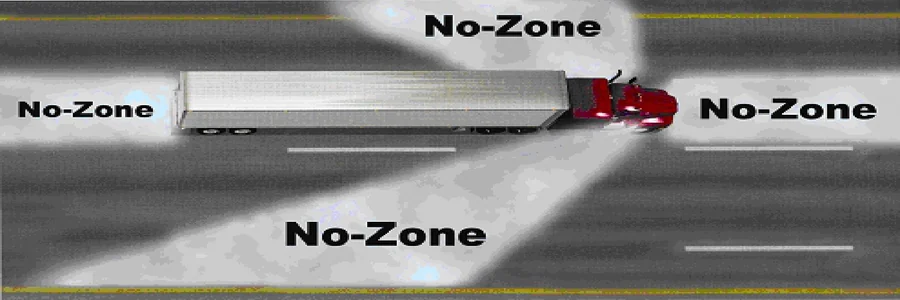
Truck no-zones (blind spots)
Large-vehicle blind spots (No-Zones)

Know the rule

Stay out of blind spots, which are behind and on each side. If you can't see the driver's mirrors, the driver can't see you. Don't drive alongside large vehicles for long.

Handbook p. 105 ↗

Know the rule

Large vehicles block your view ahead; when following one, adjust your following distance so you can see most of the road.

Handbook p. 105 ↗

Know the rule

When passing, keep a steady speed and don't cut in: wait until you see the cab in your rear-view mirror before merging back.

Handbook p. 105 ↗
450 feet

Stopping distance of a loaded truck with good brakes at 55 mph on a dry road

Handbook p. 105 ↗

Know the rule

Large vehicles can't speed up or stop as fast as cars. Allow extra space, and respect their safety gap when returning to your lane after passing.

Handbook p. 105 ↗

Know the rule

On sharp turns, large vehicles may need more than one lane. Turning right, they may angle into the left lane first; never squeeze by on their right.

Handbook p. 106 ↗

Know the rule

Vehicles carrying hazardous materials are placarded and must stop at all railroad crossings. Be ready to stop behind one.

Handbook p. 106 ↗

Know the rule

On long, steep grades, large vehicles go slowly and use the right lane on four-lane roads. Never park in or near escape (runaway) ramps; they're only for vehicles whose brakes have failed.

Handbook p. 106 ↗

Know the rule

Snowplow blades throw snow up and off the road, creating blizzard-like conditions for drivers following too closely.

Handbook p. 105 ↗

Pilot vehicle

A specially marked vehicle with amber lights that escorts an oversized load, warning traffic and guiding the load past bridges, curves, and other hazards.

Handbook p. 106 ↗

Know the rule

Meeting an oncoming pilot vehicle: slow down and move as far right as possible. Following one: increase your following distance. Be very cautious passing a pilot vehicle or the load.

Handbook p. 106 ↗

Put it into practice

A semi ahead signals right and swings into the left lane. Don't slip into the gap on its right: it needs that space to make the turn without hitting the curb. Stay back until it completes the turn.

Check your understanding

Read the question, decide on an answer, then open it to check the explanation. These are Roadwise study questions based on the source handbook.

A loaded truck traveling 55 mph on dry pavement with properly adjusted brakes needs about how many feet to stop?
  1. 700 feet
  2. 150 feet
  3. 450 feet
  4. 250 feet

Answer: 450 feet

The handbook cites 450 feet as the stopping distance for a loaded truck at 55 mph.
Handbook p. 105 ↗
If you can't see a large truck's mirrors, you should assume:
  1. it doesn't matter if you're briefly there
  2. the driver can still see you in a wide mirror
  3. the truck has a rear camera covering that area
  4. the truck driver can't see you

Answer: the truck driver can't see you

If you can't see the driver's mirrors, they likely can't see you either.

Handbook p. 105 ↗
When passing a large vehicle, you should keep a steady speed and see its cab in your mirror before:
  1. merging back into your lane
  2. signaling your intent to pass
  3. slowing down suddenly
  4. changing lanes again immediately

Answer: merging back into your lane

Confirm you can see the truck's cab before merging back in.

Handbook p. 105 ↗
Large vehicles making a right turn sometimes angle into the left lane first because:
  1. it's a shortcut through the intersection
  2. they need extra room to avoid hitting the curb
  3. the driver missed the turn
  4. they're trying to change lanes

Answer: they need extra room to avoid hitting the curb

Large vehicles need extra swing room to complete tight right turns.

Handbook p. 106 ↗
Vehicles carrying hazardous materials must:
  1. avoid crossings entirely
  2. yield only at unmarked crossings
  3. stop at all railroad crossings
  4. use a separate escort at every crossing

Answer: stop at all railroad crossings

Hazmat vehicles are required to stop at every railroad crossing.

Handbook p. 106 ↗
If you meet an oncoming pilot vehicle escorting an oversized load, you should:
  1. maintain your speed and lane position
  2. slow down and move right
  3. flash your lights to signal the escort
  4. speed up to pass quickly

Answer: slow down and move right

Slow down and move right to safely pass a pilot vehicle and its load.

Handbook p. 106 ↗
Take the lesson checkpoint in the app

More in Sharing the Road