Idaho has no annual safety inspection, so keeping your car legal is on you. If an officer stops you and finds unsafe or missing equipment, you can be cited. Learn the minimum distances each part must meet; they show up on the test.
Know the rule
You may not drive a mechanically unsafe vehicle. If it needs repairs, lacks vital equipment, or is otherwise dangerous, you are responsible for fixing it.
Handbook p. 38 ↗Know the rule
Driving someone else's vehicle without the owner's consent, intending to temporarily deprive them of it (but not to steal it), is a misdemeanor.
Handbook p. 38 ↗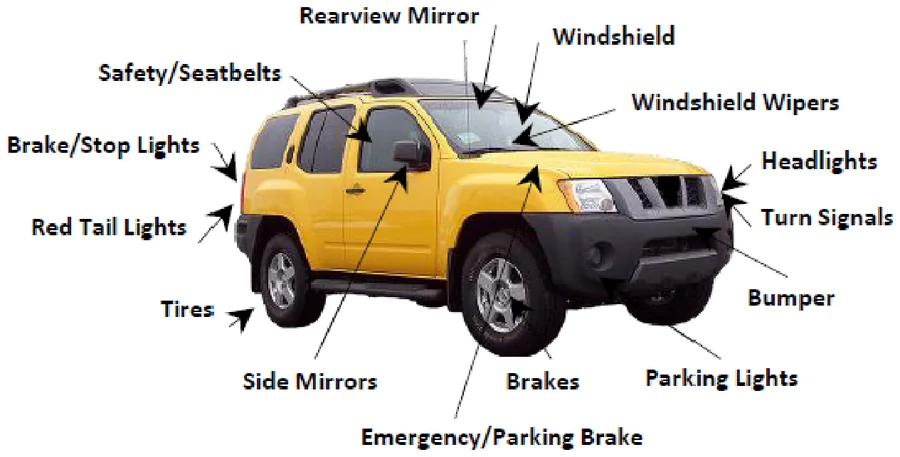
Brakes (from 20 mph on dry pavement)
| Brake | Must stop within | Also |
|---|---|---|
| Foot brake | 25 feet | Two systems: if one fails, the other works |
| Emergency/parking brake | 55 feet | Must hold the car still on a hill |
Lights: how far they must reach
| Equipment | Distance |
|---|---|
| High beams: see people and vehicles | At least 350 feet |
| Low beams: light the roadway ahead | At least 100 feet |
| Brake lights (red or amber), in sunlight | At least 100 feet to the rear |
| Two red taillights (most vehicles) | Visible from 500 feet to the rear |
| Turn signals (built after Jan. 1, 1955) | Visible from 100 feet |
Know the rule
Two headlamps with high and low beams are required, aimed so they don't blind oncoming drivers. Never cover headlights with reflective, opaque, or non-transparent material.
Handbook p. 38 ↗Know the rule
Vehicles built before January 1, 1956, and motorcycles need at least one red rear light. Brake lights must come on with the foot brake; keep their lenses clean.
Handbook p. 39 ↗Know the rule
Front turn signals must be white or amber; rear signals red or amber, with a switch the driver controls.
Handbook p. 39 ↗Minimum tire tread depth
Handbook p. 39 ↗Your horn must be heard at least this far away (unreasonably loud or harsh horns are banned)
Handbook p. 39 ↗Windows and windshields must:
- Be made of approved safety glass
- Be replaced when damage blocks the driver's view
- Be free of signs or stickers not required by law, and not blocked by hanging objects
- Be kept clear of frost, snow, dirt, or anything that obscures visibility
- Not be mirror-coated or treated so they're hard to see through, even from outside
Know the rule
Mirrors: a rear-view mirror must show at least 200 feet behind you. If a load or trailer blocks the rear window, or there's no rear-view mirror, you need left and right side mirrors.
Handbook p. 40 ↗Know the rule
Every vehicle also needs windshield wipers, a working muffler that prevents loud or unusual noise, and fenders, wheel covers, or flaps to stop mud and water from being thrown onto others.
Handbook p. 40 ↗Put it into practice
An officer stops you because your horn is broken and your only rear-view mirror is gone. Even without an inspection program, both are required equipment and you can be cited; fix them before driving again.