A 3-minute lesson from the Idaho course. Read the rules and examples, follow the handbook page references, and check your understanding before you move on.
Most crashes are caused by driver error, including other drivers' errors. Defensive driving means seeing trouble early, expecting the worst, and deciding what to do before you're forced to react.
Give plenty of room to drivers who may not see you:
Drivers entering from intersections or driveways with blocked views
Drivers backing out of driveways or parking spaces
Drivers whose windows are covered with ice or snow
Help drivers in trouble: if someone passes as you approach a curve, hill, or oncoming car, slow down and let them back in. Make room for a driver about to be forced into your lane.
Keep both hands on opposite sides of the wheel at about the nine o'clock and three o'clock positions. Check your owner's manual for hand placement with airbags.
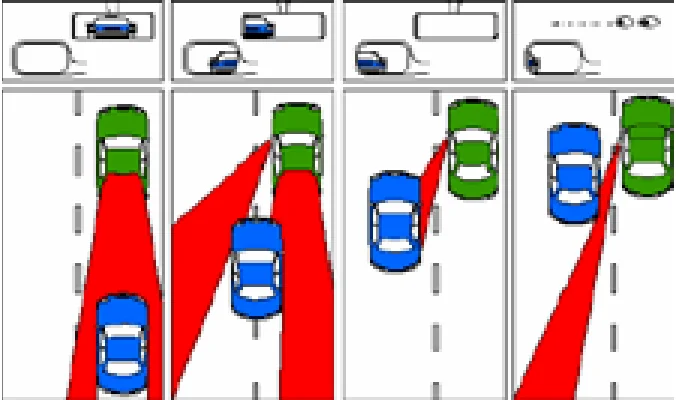
Check traffic behind you several times a minute to spot tailgaters and fast or passing vehicles. Most rear-end collisions are caused by vehicles following too closely.
You see kids playing on a corner ahead. Identify them as a hazard, predict that one may run into the street, decide to slow and cover your brake, and execute that early and smoothly.
Check your understanding
Read the question, decide on an answer, then open it to check the explanation. These are Roadwise study questions based on the source handbook.
Good drivers keep an eye on what's happening how far ahead?
About 10 to 15 seconds ahead
2 to 3 seconds ahead
Only the car directly in front
30 to 45 seconds ahead
Answer: About 10 to 15 seconds ahead
Looking 10-15 seconds ahead helps you avoid last-minute reactions.