Roadwise States Florida Driving lessons Trucks, buses and the No-Zone Florida driving lesson · Sharing the Road
Trucks, buses and the No-Zone A 3-minute lesson from the Florida course. Read the rules and examples, follow the handbook page references, and check your understanding before you move on.
Read time 3 minutes
Course unit Sharing the Road
Checkpoint questions 6
Source pages 68, 90, 92 Commercial motor vehicles (CMVs) such as semi-trucks and travel buses are heavy, slow to stop and blind in large areas around them. Most crashes with them happen when a car sits where the driver can't see it or cuts in too soon.
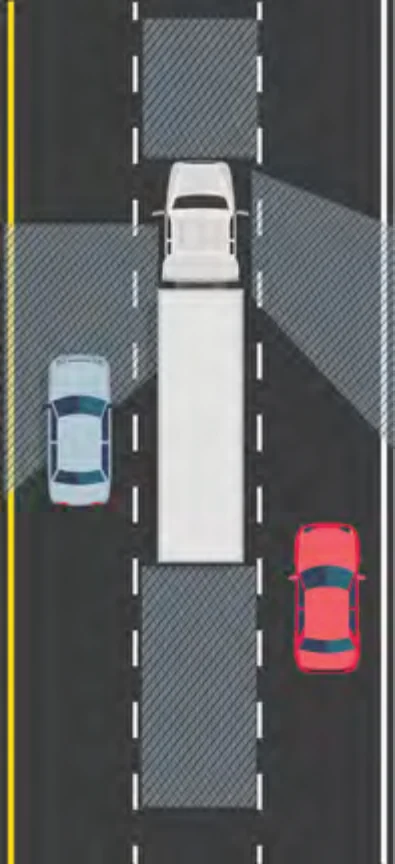
No-Zone The large blind spots in front of, behind and on both sides of a CMV, where other vehicles are hidden from the driver despite several mirrors.
Handbook p. 90 ↗ No-Zones: blind areas around a truck Rules for motorists around CMVs: Stay out of the No-Zone Don't tailgate; you're in the rear blind spot and may hit the CMV if it stops suddenly Stopped behind a CMV on an upgrade, leave room in case it drifts back; keep left in your lane Don't use high beams following a CMV at night; they reflect off its big mirrors Handbook p. 90 ↗ Also: When a CMV comes from the opposite direction, keep right to avoid a sideswipe CMVs swing wide left to turn right; never drive between the CMV and the curb Never cross behind a CMV that is backing up or preparing to Handbook p. 92 ↗ Passing a CMV: Check front and rear; move over only if clear; signal and blink your headlights Pass on the left for maximum visibility, and finish quickly Don't cut in too soon; see the cab in your rear-view mirror before moving back Avoid passing on a downgrade; its weight and momentum speed it up Handbook p. 92 ↗ Know the rule
CMV drivers may flash their headlights to let you know it's OK to merge back in.
Handbook p. 92 ↗ Know the rule
When a CMV passes you, keep to the right side of your lane and don't speed up.
Handbook p. 92 ↗ Know the rule
Large trucks and SUVs have blind spots close to the rear that can't be seen in rear-view mirrors.
Handbook p. 68 ↗ Put it into practice
A tractor-trailer ahead signals right and swings into the left part of its lane. Don't squeeze into the gap on its right. It's turning right and can't see you there. Stay back until it completes the turn.
A useful reminder Before moving back in front of a truck you passed, you should see its whole cab in your rear-view mirror.
Check your understanding Read the question, decide on an answer, then open it to check the explanation. These are Roadwise study questions based on the source handbook.
What should motorists avoid doing near commercial motor vehicles (CMVs) due to their blind spots? Tailgating them, staying out of the 'No Zone' Passing them on the left side Passing them at all Flashing headlights when passing Answer: Tailgating them, staying out of the 'No Zone'
Stay out of the 'No Zone' and don't tailgate; CMVs have large blind spots in front, behind, and on both sides.
Handbook p. 90 ↗ When passing a CMV, on which side should you pass for maximum visibility? Either side is equally safe The left side The right side Whichever side has less traffic Answer: The left side
Pass CMVs on the left side for maximum visibility and complete the pass as quickly as possible.
Handbook p. 92 ↗ Before merging back in front of a CMV after passing, what should you be able to see? The CMV's headlights flashing The CMV's rear tires in your side mirror The CMV's cab in your rear-view mirror Nothing, you can merge immediately Answer: The CMV's cab in your rear-view mirror
Be sure you can see the cab of the CMV in your rear-view mirror before completing your pass, to avoid cutting in too soon.
Handbook p. 92 ↗ Why should you avoid passing a CMV on a downgrade? Its brakes lock up on hills Downgrades are illegal passing zones Its trailer sways to the left Its momentum will speed it up Answer: Its momentum will speed it up
Avoid passing a CMV on a downgrade because its weight and momentum will cause it to increase speed.
Handbook p. 92 ↗ If you are stopped behind a CMV on an upgrade, what should you do? Leave room in case it rolls back Keep to the right in your lane Switch to a different lane immediately Pull up as close as possible Answer: Leave room in case it rolls back
Leave space in case the CMV drifts back when starting to move, and keep to the left in your lane so the driver can see you.
Handbook p. 90 ↗ Why shouldn't you drive between a right-turning CMV and the curb? That space is reserved for bicycles It swings wide left and can't see you Its trailer may roll backward CMV right turns are illegal in cities Answer: It swings wide left and can't see you
CMVs often need to swing wide to the left to make a right turn; don't drive between the CMV and the curb because they won't see you.
Handbook p. 90 ↗ Previous lesson Rules for bicyclists Next lesson Emergency vehicles, funerals, transit and slow vehicles About the source Roadwise’s Florida course uses the driver handbook edition supplied with this study pack. This lesson cites source pages 68, 90, 92. The linked PDF is a third-party mirror of the handbook, rather than a government-hosted page.
Open the handbook source PDF · View the source edition
For current application requirements, fees, appointments, and the format that applies to your age or license type, check Florida’s FLHSMV. Roadwise provides study material and does not issue permits or licenses.