roadwise.Open study app

Delaware driving lesson · Speed & Parking

How to park: parallel, hills & leaving your car

A 3-minute lesson from the Delaware course. Read the rules and examples, follow the handbook page references, and check your understanding before you move on.

Read time
3 minutes
Course unit
Speed & Parking
Checkpoint questions
5
Source pages
89, 90, 127

Parking safely means getting close to the curb, securing the car so it can't roll, and getting out without stepping or swinging a door into traffic. You'll show parallel parking on your road test.

Know the rule

When you leave your vehicle on a highway or street, stop the engine, lock the ignition, remove the key and set the brakes; raising the windows and locking the doors is advisable. It's illegal to leave keys in a running, unattended vehicle.

Handbook p. 89 ↗
12 in

Maximum distance from the curb or edge when parked parallel on a two-way highway

Handbook p. 89 ↗

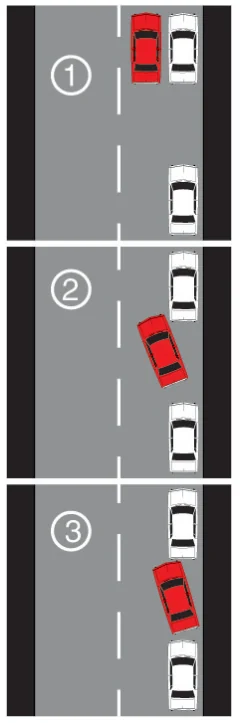
Parallel parking steps:

  • Check your mirror; if someone is following too closely, don't stop suddenly—find another space. Signal.
  • Stop with your back end even with the back of the car in front of the space
  • Back slowly, turning the wheel right to aim toward the front of the car behind
  • When your front clears the car ahead, turn sharply left and back until nearly touching the car behind
  • Straighten the wheels, pull forward to center, shift to park, set the brake, turn off the engine
Handbook p. 89 ↗
Parallel parking steps 1-3 diagram
Parallel parking, steps 1–3

Know the rule

To park at the left curb of a one-way street, follow the same steps with left and right reversed. To leave a space, signal, watch for traffic and turn the wheel toward the open lane.

Handbook p. 89 ↗

Know the rule

If traffic is coming behind you, signal, pull next to the space, and let following vehicles pass before you park.

Handbook p. 127 ↗

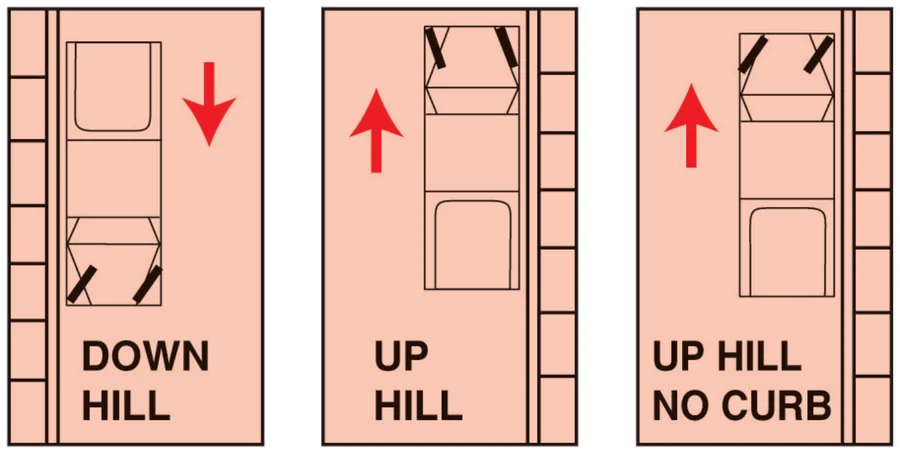
Parking on a hill

Parking on a hill
SituationFront wheels
Headed downhillToward the curb or edge of the road
Headed uphill, with a curbAway from curb; near front wheel against it
Headed uphill, no curbToward the edge of the highway
Handbook p. 90 ↗
Parking on a hill: downhill, uphill, uphill no curb (composite)
Wheel positions: downhill, uphill, uphill with no curb

Know the rule

With a manual transmission, leave it in low gear facing uphill and in reverse facing downhill, in case the parking brake fails.

Handbook p. 89 ↗

Know the rule

Never open a door into traffic or so that it endangers anyone. Use the curb-side door, or check for oncoming vehicles—especially bicyclists—before opening the street-side door.

Handbook p. 90 ↗

Put it into practice

You park facing uphill on a street with a curb. Turn the front wheels away from the curb and let the near-side front tire rest against it, set the parking brake, and leave the car in gear.

Check your understanding

Read the question, decide on an answer, then open it to check the explanation. These are Roadwise study questions based on the source handbook.

When parallel parking on a two-way highway, your vehicle must be parked within
  1. 6 inches of the curb
  2. 12 inches of the curb
  3. 24 inches of the curb
  4. 36 inches of the curb

Answer: 12 inches of the curb

Parallel parking requires your vehicle to be within 12 inches of the curb or edge of the highway.
Handbook p. 89 ↗
When parked facing downhill, your front wheels should be turned
  1. away from the curb
  2. straight ahead
  3. toward the curb or edge of the road
  4. either way, if the parking brake is set

Answer: toward the curb or edge of the road

When headed downhill, turn your front wheels toward the curb or edge of the road so the vehicle rolls into it if the brake fails.

Handbook p. 90 ↗
When parked facing uphill on a street with a curb, your front wheels should be turned
  1. toward the curb
  2. straight, with the parking brake set
  3. toward the curb, in low gear
  4. away from the curb, with the near-side wheel touching it

Answer: away from the curb, with the near-side wheel touching it

Facing uphill with a curb present, turn your front wheels away from the curb and let the near-side wheel rest against it.

Handbook p. 90 ↗
When leaving your vehicle parked on a highway or street, you must
  1. stop the engine and set the brake; the key may stay
  2. stop the engine, lock the ignition, remove the key, and set the brake
  3. set the brake and leave the engine idling
  4. lock the doors and leave the parking lights on

Answer: stop the engine, lock the ignition, remove the key, and set the brake

When parking and leaving your vehicle, you must stop the engine, lock the ignition, remove the key, and set the brakes.

Handbook p. 89 ↗
You may leave your keys in the ignition of a running, unattended vehicle while you run into a store.
  1. True
  2. False

Answer: False

It is against the law to leave keys in a running, unattended vehicle.

Handbook p. 89 ↗
Take the lesson checkpoint in the app

More in Speed & Parking