A 3-minute lesson from the Delaware course. Read the rules and examples, follow the handbook page references, and check your understanding before you move on.
When a crash looks likely, many drivers panic and freeze. You have three options: stop, turn or speed up. You can usually turn faster than you can stop. If a crash can't be avoided, belts and body position reduce injuries.
Stopping quickly
Stopping quickly
Vehicle
How
With ABS
Press hard and hold; don't let up if the pedal pushes back
Without ABS
Brake hard without locking; if wheels lock, ease off
Without ABS, if the wheels lock and you feel a skid, quickly let up on the brake, then push down again as soon as the skid stops. Repeat until you've stopped.
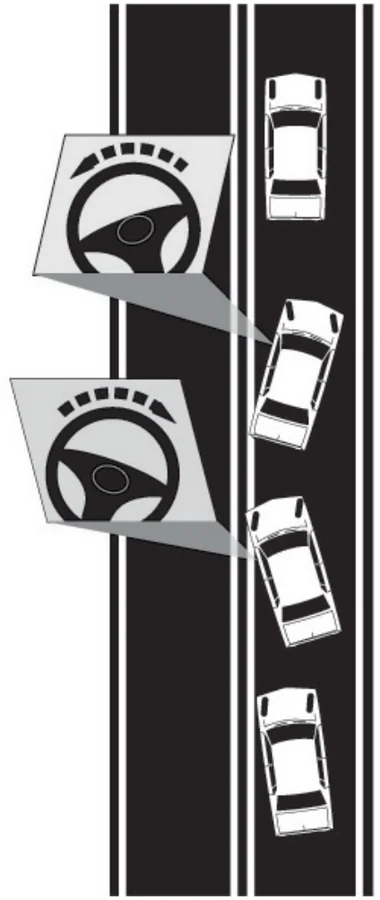
To turn quickly, grip the wheel with both hands and steer where you want to go. With ABS you can turn while braking; without ABS, brake, let up, then turn—don't lock the front wheels or turn so sharply the car plows ahead.
Speeding up can avoid a crash when another vehicle is about to hit you from the side or behind and there's room ahead. Slow down once the danger has passed.
A car pulls out right in front of you on a wet road and your car has no ABS. Brake hard without locking the wheels, let up, and steer around it—turning is usually quicker than stopping.
Check your understanding
Read the question, decide on an answer, then open it to check the explanation. These are Roadwise study questions based on the source handbook.
With Anti-Lock Brakes (ABS), during an emergency stop you should
pump the brake pedal repeatedly
press the brake pedal hard and keep holding it down
release the brake the moment you feel it pulse
avoid braking and only steer
Answer: press the brake pedal hard and keep holding it down
With ABS, press the brake pedal as hard as you can and keep pressing; the pulsing feeling means the system is working.