roadwise.Open study app

Connecticut driving lesson · Sharing the Road

Trucks, buses, RVs and No-Zones

A 4-minute lesson from the Connecticut course. Read the rules and examples, follow the handbook page references, and check your understanding before you move on.

Read time
4 minutes
Course unit
Sharing the Road
Checkpoint questions
6
Source pages
21, 22

Trucks, buses and RVs are longer, higher and wider than cars. They speed up slowly, need much more room to stop and turn, and have huge blind spots called No-Zones. Stay out of them, pass promptly, and never cut in close in front.

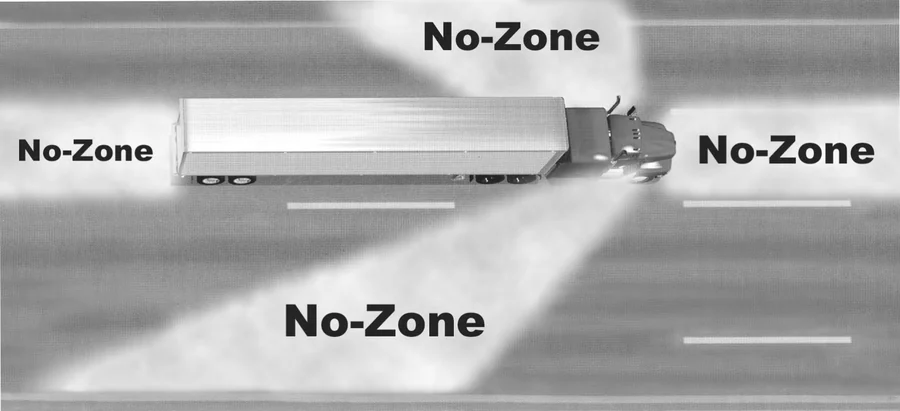
Truck No-Zone blind spots
No-Zones: blind spots beside, in front of and behind a truck

No-Zone

The danger areas around trucks, tractor-trailers, buses and RVs where crashes are more likely, including blind spots where your car disappears from the driver's view.

Handbook p. 21 ↗

The No-Zones:

  • Side: far larger than a car's blind spots — can't see the driver's face in his mirror? He can't see you
  • Rear: directly behind; the driver can't see you and you can't see traffic ahead
  • Front: cutting in too soon after passing — these vehicles need nearly twice the time and room to stop
  • Wide turns: they swing wide left or right and can't see cars directly behind or beside them
Handbook p. 21 ↗

Truck size and blind spots

Truck size and blind spots
MeasureDistance
Truck plus tow vehicle lengthAs long as 65 feet
Clear road needed to pass oneMore than half a mile
Blind spot in front of the cabUp to 20 feet
Blind spot behind the truckAbout 200 feet
Handbook p. 21 ↗

Passing trucks safely:

  • Pass only where you can finish without excessive speed or a no-passing zone
  • Complete the pass promptly — don't linger beside the cab
  • Return to the lane when you see the truck's front in your inside mirror, then keep your speed up
  • Avoid pulling in front of a truck when traffic may slow or stop
  • If a truck passes you, slow down slightly — never speed up (dangerous and illegal)
  • Meeting a truck going the other way, keep as far right as you safely can
Handbook p. 21 ↗
3 seconds

Never follow a truck at a time interval of less than this

Handbook p. 22 ↗

Know the rule

Never use high beams following a truck at night — glare in its big mirrors can blind the driver. Don't stop too close behind a truck on an upgrade; it may roll back. Stopping a little to one side lets the driver see you.

Handbook p. 22 ↗

Off-track

On turns, a vehicle's rear wheels follow a shorter path than the front wheels; the longer the vehicle, the shorter the rear path. Trucks may first swing left before a right turn.

Handbook p. 22 ↗

Know the rule

Don't pass on the right of a truck approaching an intersection — if it turns right you could be caught between the truck and the curb.

Handbook p. 22 ↗

Know the rule

If a truck driver is trying to back into a loading area, stop and give room. Never drive around a backing truck.

Handbook p. 22 ↗

Other hints:

  • If a truck slows, stops, signals or changes lanes, there's a reason — slow down and hold your position
  • Let entering traffic merge; never cut across several lanes from an on-ramp
  • Some trucks must stop at railroad crossings — be ready
  • With two or more lanes your way, stay in the right lane except to pass
  • With three or more lanes your way, use the center lane if there is a lot of entering or exiting traffic
  • Never drive on the shoulder unless officials tell you to
Handbook p. 22 ↗

Put it into practice

You're behind a tractor-trailer and can't see its side mirrors. That means the driver can't see you. Drop back to at least three seconds, and if you pass, do it promptly and return only when the truck's whole front shows in your mirror.

Check your understanding

Read the question, decide on an answer, then open it to check the explanation. These are Roadwise study questions based on the source handbook.

About how far can a truck's blind spot extend behind the truck?
  1. Approximately 500 feet
  2. Approximately 50 feet
  3. Approximately 20 feet
  4. Approximately 200 feet

Answer: Approximately 200 feet

A truck's blind spots may stretch up to 20 feet in front of the cab and approximately 200 feet behind the truck.
Handbook p. 21 ↗
How can you tell if a truck driver can see your vehicle in their side mirror?
  1. If you see their face in the mirror
  2. If you can see the truck's side mirror
  3. Flash your headlights to check
  4. If you are behind the trailer

Answer: If you see their face in the mirror

If you can't see the driver's face in his side view mirror, then he can't see you.

Handbook p. 21 ↗
What following distance interval should you maintain behind a truck at minimum?
  1. Never less than two seconds
  2. Never less than three seconds
  3. Never less than one second
  4. A fixed distance of 10 feet

Answer: Never less than three seconds

Never follow a truck at a time interval of less than three seconds.

Handbook p. 22 ↗
About how long can a truck and its tow vehicle combination be, and how much clear road may be needed to pass it?
  1. Up to 40 feet; about 500 feet to pass
  2. Up to 65 feet; over half a mile to pass
  3. Up to 100 feet; over a mile to pass
  4. Up to 30 feet; about 1,000 feet to pass

Answer: Up to 65 feet; over half a mile to pass

A truck and its tow vehicle may be as long as 65 feet, and it may take more than half a mile of clear road to pass.

Handbook p. 21 ↗
What should you do if you see a truck driver attempting to back up?
  1. Flash your lights so the driver sees you
  2. Pass on the left immediately
  3. Stop and let them back up safely
  4. Drive around the truck quickly

Answer: Stop and let them back up safely

If you see a truck driver attempting to back, stop to give them a chance to do so safely.

Handbook p. 22 ↗
What should you do if a truck passes you on the highway?
  1. Speed up to make the truck pass faster
  2. Change lanes immediately
  3. Slow down slightly to shorten the time it takes to pass
  4. Flash your high beams at the truck

Answer: Slow down slightly to shorten the time it takes to pass

If a truck passes you, slow down slightly to shorten the time required for the pass; never speed up.

Handbook p. 22 ↗
Take the lesson checkpoint in the app

More in Sharing the Road