roadwise.Open study app

Connecticut driving lesson · Sharing the Road

Bicyclists and vulnerable users

A 4-minute lesson from the Connecticut course. Read the rules and examples, follow the handbook page references, and check your understanding before you move on.

Read time
4 minutes
Course unit
Sharing the Road
Checkpoint questions
6
Source pages
18, 19

On the road a bicycle is a vehicle, with the same rights and duties as you. Cyclists are hard to see and easily hurt, so Connecticut requires 3 feet when you pass, doubles fines for failing to yield to them, and protects them as 'vulnerable users'.

Vulnerable users

Pedestrians, bicyclists, wheelchair users, people riding or driving an animal, highway workers, garbage trucks, tank vehicles, US mail vehicles and express delivery carriers.

Handbook p. 18 ↗

Know the rule

The Vulnerable User's Law sets higher penalties for drivers who fail to use reasonable care and cause serious injury or death of a vulnerable user. Drivers must allow three feet of distance when passing.

Handbook p. 18 ↗

Bicyclists must:

  • Ride on the right side, as far right as they judge safe
  • Obey all traffic signs and signals and use hand signals
  • Yield to pedestrians
  • Wear a helmet if under 16 years of age
Handbook p. 19 ↗

Know the rule

A cyclist going straight may ride in the left-hand edge of a right-turn lane. In a lane too narrow to share, the cyclist may 'take the travel lane' (ride in or near its center), and may use the full lane when the shoulder or bike lane is unsafe.

Handbook p. 19 ↗

As a driver you must:

  • Yield to bicyclists in intersections as you would to pedestrians and other vehicles
  • Yield where a bike path or bike lane crosses the road
  • Yield to cyclists in a bike lane or people on a sidewalk before turning across it
  • Pass only with at least three feet between you and the bicycle (count your load or trailer)
  • After passing, not slow down, stop quickly or turn right right away
Handbook p. 19 ↗

Know the rule

Fines are doubled for failure to yield the right-of-way to a bicyclist.

Handbook p. 19 ↗

Know the rule

Don't sound your horn close to bicyclists unless you have good cause — it may startle them into your path.

Handbook p. 19 ↗

Know the rule

Do not stop, park or drive in a bicycle lane unless entering or leaving an alley or driveway, performing official duties, directed by police, or in an emergency. You may turn across a bike lane but may not drive in it when approaching a turn.

Handbook p. 19 ↗

Know the rule

You may pass slow-moving vehicles, including bicyclists, in a no-passing zone if you can do it safely.

Handbook p. 19 ↗
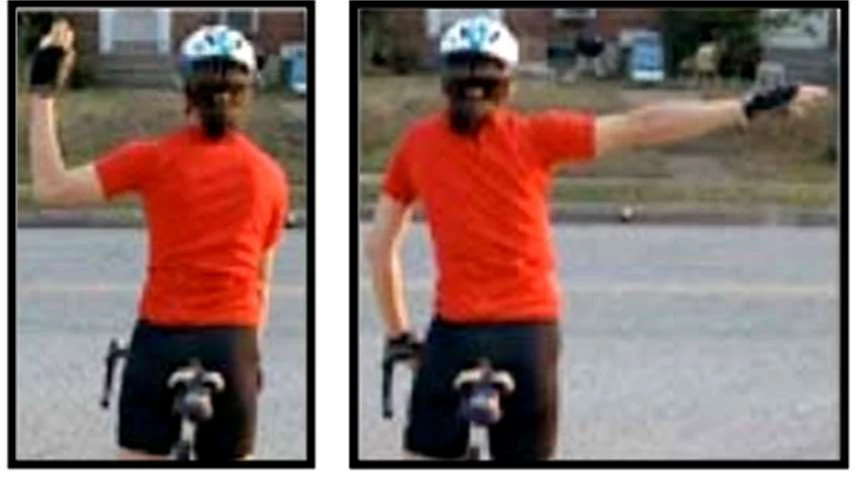
Hand signal right turn
Bicyclist hand signals for a right turn

Know the rule

Cyclists may be unable to signal when they need both hands on the handlebars; watch for head turns and looks over the shoulder. Take extra care when roads are wet or covered with sand or gravel, and check for cyclists before opening doors or backing.

Handbook p. 19 ↗

Put it into practice

You're about to turn right just past a cyclist riding along the curb. Don't pass and cut in front. Slow down, let the cyclist clear the intersection, then make your turn.

Check your understanding

Read the question, decide on an answer, then open it to check the explanation. These are Roadwise study questions based on the source handbook.

How much distance must a driver allow when passing a bicyclist?
  1. At least 1 foot
  2. At least 10 feet
  3. At least 3 feet
  4. At least 6 feet

Answer: At least 3 feet

Drivers must allow at least three feet of space between their vehicle and a bicycle when passing.
Handbook p. 19 ↗
What happens to fines for failing to yield the right-of-way to a bicyclist?
  1. Fines stay the same as any other violation
  2. Fines are reduced by half
  3. No fine applies, only a warning
  4. Fines are doubled

Answer: Fines are doubled

Fines are doubled for failure to yield right-of-way to a bicyclist.

Handbook p. 19 ↗
Under what age must a bicyclist wear a helmet under Connecticut law?
  1. Under 14 years of age
  2. Under 16 years of age
  3. Under 12 years of age
  4. Under 18 years of age

Answer: Under 16 years of age

Bicyclists are required to wear a helmet if they are under 16 years of age.

Handbook p. 19 ↗
You are about to make a right turn just after passing a bicyclist. What should you do?
  1. Sound your horn and turn quickly
  2. Let the cyclist clear the intersection first
  3. Turn immediately to clear the intersection first
  4. Speed up to get ahead of the cyclist

Answer: Let the cyclist clear the intersection first

To avoid a collision, slow down and let the cyclist clear the intersection before making your turn.

Handbook p. 19 ↗
May a driver stop or park in a designated bicycle lane?
  1. No, except limited cases such as entering a driveway
  2. Yes, anytime there's no bicyclist nearby
  3. Yes, for up to 15 minutes
  4. No, never, not even in an emergency

Answer: No, except limited cases such as entering a driveway

Do not stop, park, or drive in a bicycle lane unless entering/leaving an alley or driveway, on official duty, or in an emergency.

Handbook p. 19 ↗
May a driver briefly drive in a bicycle lane when approaching a turn?
  1. Yes, driving in the bike lane before turning is allowed
  2. No; you may cross it to turn but not drive in it
  3. Yes, but only for right turns
  4. No, you may never cross a bicycle lane

Answer: No; you may cross it to turn but not drive in it

You may turn across a bicycle lane but may not drive in the bicycle lane when approaching a turn.

Handbook p. 19 ↗
Take the lesson checkpoint in the app

More in Sharing the Road