roadwise.Open study app

Colorado driving lesson · Lane Controls & Right-of-Way

Lane rules & special-use lanes

A 3-minute lesson from the Colorado course. Read the rules and examples, follow the handbook page references, and check your understanding before you move on.

Read time
3 minutes
Course unit
Lane Controls & Right-of-Way
Checkpoint questions
6
Source pages
12, 13, 14

Most lanes are open to everyone, but some are reserved: for bikes, transit, carpools or left turns only. Signs and markings, often a white diamond, tell you who may use them and when.

Know the rule

As a general rule, drive on the right half of the road. Use only one lane; do not straddle lanes.

Handbook p. 12 ↗

Know the rule

On roads without marked lanes, drive just to the right of the center of the road and don't drive on the shoulder. The same passing and turning rules apply.

Handbook p. 13 ↗

Know the rule

Restricted lanes are marked by signs or pavement markings; there may be a white diamond in the lane and/or a sign stating its use (for example, transit or bicycle lanes).

Handbook p. 13 ↗

Know the rule

Bike lanes are for the exclusive use of bicyclists and other authorized users, who have the right-of-way there. Drivers may not drive, idle, park in or otherwise block a bike lane.

Handbook p. 13 ↗

Know the rule

A bike lane continues through an intersection whether or not paint connects it on both sides.

Handbook p. 13 ↗

Transit lane

Part of the street, marked by signs and markings, reserved for preferential or exclusive use by transit vehicles such as buses or light rail, sometimes with limited use by others.

Handbook p. 13 ↗
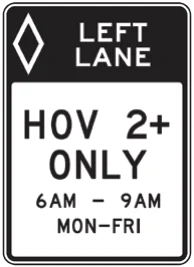
HOV lane
HOV lane sign

HOV lane

A High Occupancy Vehicle lane, marked with a white diamond. Signs say which vehicles and how many occupants per vehicle may use it.

Handbook p. 13 ↗
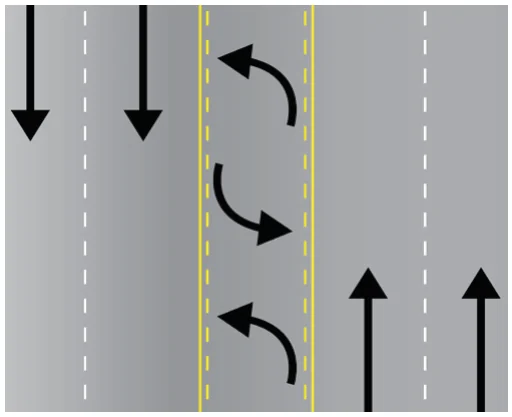
Two-way left turn lane markings
Two-way left-turn lane

Know the rule

A two-way left-turn (center turn) lane is only for vehicles turning left, from either direction. Never use it to pass or travel. You may stop in it until it's safe to turn.

Handbook p. 13 ↗

Know the rule

Where a street has a shared center turn lane, you may not turn left from any other lane.

Handbook p. 13 ↗

Reversible lanes

Lanes carrying traffic one way at some times and the opposite way at others, separated by a barrier or double-broken yellow lines, with side/overhead signs or special lights.

Handbook p. 13 ↗

Diverging Diamond Interchange (DDI)

An interchange that crosses traffic to the opposite side of the road so vehicles move onto freeway ramps without interruption, eliminating left-turn conflicts.

Handbook p. 14 ↗

Put it into practice

You need to turn left into a shopping center from a street with a center turn lane. Move into the center lane, stop there if needed until traffic clears, then turn. Don't drive along it or use it to get around slow traffic.

Check your understanding

Read the question, decide on an answer, then open it to check the explanation. These are Roadwise study questions based on the source handbook.

As a general rule, on which side of the road must you drive?
  1. The left half
  2. Whichever side has less traffic
  3. The right half
  4. The center of the road

Answer: The right half

As a general rule, you must drive your vehicle on the right half of the road.
Handbook p. 12 ↗
On a road with no marked lanes, where should you drive?
  1. Wherever there is the least traffic
  2. Just right of the road's center
  3. On the far right shoulder
  4. In the exact center of the road

Answer: Just right of the road's center

On roads without marked lanes, drive just to the right of the center of the road.

Handbook p. 13 ↗
What marking commonly identifies a restricted-use or HOV lane on the pavement?
  1. A white diamond
  2. A yellow triangle
  3. A blue square
  4. A red circle

Answer: A white diamond

Restricted and HOV lanes are marked with a white diamond painted on the roadway, along with signs.

Handbook p. 13 ↗
May a driver use a two-way left-turn (center turn) lane to pass another vehicle?
  1. No, it's for left turns only
  2. Yes, if signaling first
  3. Yes, but only on four-lane roads
  4. Yes, if traffic is light

Answer: No, it's for left turns only

The two-way left-turn lane is exclusively for left-turning vehicles and may not be used for passing or general travel.

Handbook p. 13 ↗
Reversible lanes, which carry traffic in different directions at different times, are often separated by what?
  1. A single dashed white line
  2. A barrier or double-broken yellow lines
  3. Orange cones only
  4. A solid green line

Answer: A barrier or double-broken yellow lines

Reversible lanes are separated by a barrier or marked by double-broken yellow lines, with signs or special lights.

Handbook p. 13 ↗
Are drivers allowed to idle or park in a bike lane?
  1. Yes, if no bicyclists are present
  2. Yes, for up to 5 minutes
  3. No, this is prohibited
  4. Yes, if hazards are on

Answer: No, this is prohibited

Drivers are prohibited from driving, idling, or parking in a bike lane or otherwise obstructing it.

Handbook p. 13 ↗
Take the lesson checkpoint in the app

More in Lane Controls & Right-of-Way