roadwise.Open study app

Colorado driving lesson · Weather & Special Conditions

Bad weather & hydroplaning

A 3-minute lesson from the Colorado course. Read the rules and examples, follow the handbook page references, and check your understanding before you move on.

Read time
3 minutes
Course unit
Weather & Special Conditions
Checkpoint questions
6
Source pages
19

Rain, fog, ice, high winds and dust affect every vehicle, whether it's front-wheel, rear-wheel, four-wheel or all-wheel drive. The two most important things to do: slow down and increase your following distance.

Bad weather tips:

  • Use your headlights if visibility is poor
  • Don't use cruise control on wet or icy highways
  • Don't drive through large bodies of standing water
  • If a road is flooded, find another route
Handbook p. 19 ↗

Hydroplaning

When your tires ride on the water on top of wet pavement, which can cause complete loss of traction and steering control.

Handbook p. 19 ↗

Know the rule

Worn tires raise your hydroplaning risk, so check your tread depth regularly.

Handbook p. 19 ↗

If your tires lose traction (hydroplaning):

  • Take your foot off the gas to slow down
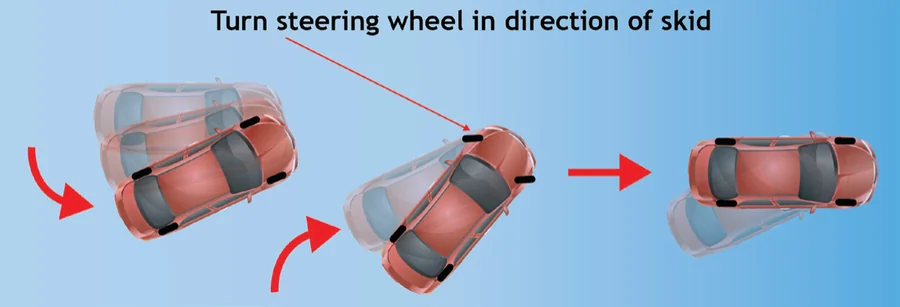
  • Slowly steer in the direction you're hydroplaning until you regain control
  • Keep steering slow; jerking the wheel can overcorrect and flip the car
  • Don't try to stop or turn until the tires grip again
Handbook p. 19 ↗

Know the rule

Steering toward the direction of the skid may seem backwards, but it helps the tires realign with the vehicle.

Handbook p. 19 ↗
Skid recovery (steer into the skid)
Turn the steering wheel in the direction of the skid

Know the rule

In rain, fog, ice, high winds and dust, the two most important actions are to slow your speed and increase your following distance.

Handbook p. 19 ↗

Put it into practice

On a wet highway, your steering suddenly feels light and the car starts sliding right. Ease off the gas and gently steer right, the way you're sliding, until the tires grip. Don't brake hard or yank the wheel.

Check your understanding

Read the question, decide on an answer, then open it to check the explanation. These are Roadwise study questions based on the source handbook.

If you feel your tires losing traction while hydroplaning, what should you do first?
  1. Brake hard immediately
  2. Turn the wheel sharply
  3. Accelerate to regain control
  4. Ease off the gas

Answer: Ease off the gas

If hydroplaning, take your foot off the gas to let the vehicle slow, then steer gently to realign.
Handbook p. 19 ↗
Does weather affect a vehicle's handling regardless of whether it has front-wheel, rear-wheel, four-wheel, or all-wheel drive?
  1. No, only rear-wheel drive vehicles are affected
  2. Yes, weather affects all drivetrains
  3. No, only front-wheel drive vehicles are affected
  4. No, four-wheel drive vehicles are unaffected

Answer: Yes, weather affects all drivetrains

Weather significantly affects how a vehicle drives regardless of its drivetrain type.

Handbook p. 19 ↗
What should you do if you see a flooded roadway ahead?
  1. Proceed at normal speed
  2. Turn on your hazard lights and drive through quickly
  3. Drive through slowly in a low gear
  4. Find another route to your destination

Answer: Find another route to your destination

The handbook advises finding another route rather than driving through large bodies of standing water on the road.

Handbook p. 19 ↗
While correcting a hydroplaning skid, how should you turn the steering wheel?
  1. Slowly, without jerking the wheel
  2. As quickly and sharply as possible
  3. Only after coming to a complete stop
  4. In the opposite direction of the skid, sharply

Answer: Slowly, without jerking the wheel

Steering needs to be slow when correcting a hydroplane; jerking the wheel or overcorrecting could cause the vehicle to flip.

Handbook p. 19 ↗
What should you check regularly to reduce your risk of hydroplaning?
  1. Your tires' tread depth
  2. Your windshield wiper fluid level
  3. Your headlight alignment
  4. Your brake fluid level

Answer: Your tires' tread depth

Tires with more wear are at increased risk of hydroplaning, so you should check tread depth regularly.

Handbook p. 19 ↗
It is safe to use cruise control on wet or icy highways.
  1. True
  2. False

Answer: False

The handbook advises not to use cruise control if the highway is wet or icy.

Handbook p. 19 ↗
Take the lesson checkpoint in the app

More in Weather & Special Conditions