Roadwise States Arkansas Driving lessons Scanning, lane changes, backing & blind spots Arkansas driving lesson · Safe Driving Basics
Scanning, lane changes, backing & blind spots A 4-minute lesson from the Arkansas course. Read the rules and examples, follow the handbook page references, and check your understanding before you move on.
Read time 4 minutes
Course unit Safe Driving Basics
Checkpoint questions 6
Source pages 60, 61, 62 Inattention is the leading cause of car crashes. Defensive drivers look far ahead, check behind, and never assume their mirrors show everything.
1 block / ¼ mile How far ahead to look: at least one city block in the city, one-quarter mile on highways and interstates
Handbook p. 60 ↗ Check that you're looking 15 seconds ahead: Pick a fixed object (a sign or pole) as far ahead as you're looking Count one-one-thousand, two-one-thousand… until you reach it The count is how many seconds ahead you were looking Handbook p. 60 ↗ Intersection Any place traffic merges or crosses: cross streets, side streets, driveways, and shopping center or parking lot entrances.
Handbook p. 60 ↗ At intersections: Look left and right, then look again toward oncoming traffic before crossing Before a right turn, check traffic from the left, oncoming left-turners, and pedestrians You may turn right on red after a complete stop unless a sign prohibits it If your view of the cross street is blocked, ease forward until you can see Handbook p. 60 ↗ Know the rule
In heavy traffic, check your rearview and side mirrors now and then to spot vehicles approaching too fast or following too closely.
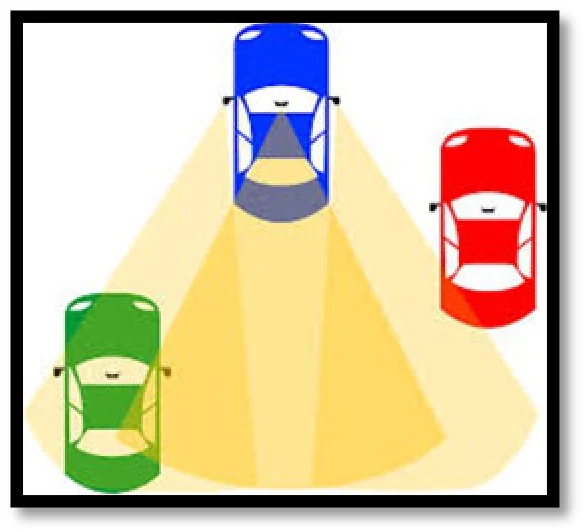
Handbook p. 61 ↗ Changing lanes safely: Check rearview and side mirrors: no one in the lane and no one about to pass you Look over your shoulder in the direction you're moving to check your blind spot Make the glance quick; traffic ahead could stop suddenly Look carefully for motorcycles, bicycles and pedestrians, especially pulling away from a curb Handbook p. 61 ↗ Blind spot An area around the vehicle the driver can't see directly from the controls, such as the rear corners that mirrors don't show.
Handbook p. 62 ↗ Know the rule
Check behind you before slowing down, and slow gradually so you don't stop suddenly where following drivers don't expect it, such as at private driveways or parking lots.
Handbook p. 62 ↗ Backing safely: Check behind the vehicle before you get in; children and small objects can't be seen from the seat Put your right arm over the seat back and turn to look through the rear and side windows Don't depend on mirrors; you can't see directly behind the vehicle Back slowly; the vehicle is much harder to steer in reverse When possible, have someone outside help you back Handbook p. 62 ↗ Blind spot tips: Don't drive on either side or slightly behind other vehicles When passing, don't stay in the other driver's blind spot Never stay alongside a large vehicle such as a tractor-trailer or bus Speed up or slow down to get out of a blind spot quickly Handbook p. 62 ↗ Blind spots around a car Put it into practice
You want to move left on the interstate. Your mirrors look clear, but you quickly glance over your left shoulder and spot a motorcycle beside your rear bumper. Wait until it passes, then signal and move over.
Check your understanding Read the question, decide on an answer, then open it to check the explanation. These are Roadwise study questions based on the source handbook.
When driving in the city, about how far ahead should you look down the road? About one city block About two city blocks About a quarter mile About a half mile Answer: About one city block
In the city, drivers should look at least one city block ahead.
Handbook p. 60 ↗ When driving on highways or interstates, about how far ahead should you look? About one city block only About one-quarter mile One-half mile One mile Answer: About one-quarter mile
On highways and interstates, drivers should look about one-quarter mile ahead.
Handbook p. 60 ↗ About how many seconds ahead should you be looking down the road? At least 5 seconds At least 30 seconds At least 15 seconds At least 45 seconds Answer: At least 15 seconds
The handbook recommends looking at least fifteen (15) seconds ahead while driving.
Handbook p. 60 ↗ Before changing lanes, what should you check in addition to your mirrors? Only the rearview mirror Only the side mirror Over your shoulder for your blind spot Nothing else is necessary Answer: Over your shoulder for your blind spot
Mirrors don't show your blind spots, so you must also glance over your shoulder before changing lanes.
Handbook p. 61 ↗ When backing up, why shouldn't you rely only on your mirrors? You cannot see directly behind your vehicle in the mirrors Mirrors cannot be adjusted while in reverse Mirrors show a wider path than reality Mirrors show vehicles but not people Answer: You cannot see directly behind your vehicle in the mirrors
Mirrors don't show what's directly behind the vehicle, so you should turn and look through the rear window.
Handbook p. 62 ↗ Your mirrors alone give you a complete view of your blind spots. True False Answer: False
Mirrors cannot show your blind spots; you must glance over your shoulder to check them.
Handbook p. 61 ↗ Previous lesson Distracted driving & Arkansas cell phone law Next lesson Headlights, horn & signals More in Safe Driving Basics About the source Roadwise’s Arkansas course uses the driver handbook edition supplied with this study pack. This lesson cites source pages 60, 61, 62. The linked PDF is a third-party mirror of the handbook, rather than a government-hosted page.
Open the handbook source PDF · View the source edition
For current application requirements, fees, appointments, and the format that applies to your age or license type, check Arkansas’s DFA. Roadwise provides study material and does not issue permits or licenses.