roadwise.Open study app

Arkansas driving lesson · Lanes, Right-of-Way & Parking

Parking rules & no-parking zones

A 3-minute lesson from the Arkansas course. Read the rules and examples, follow the handbook page references, and check your understanding before you move on.

Read time
3 minutes
Course unit
Lanes, Right-of-Way & Parking
Checkpoint questions
6
Source pages
53, 54

A parked car must never become a hazard. Park far enough from traffic not to interfere, where drivers from both directions can see you, and learn Arkansas's exact no-parking distances.

Know the rule

Park where your vehicle is far enough from the road to avoid interfering with traffic and is visible to vehicles from either direction.

Handbook p. 53 ↗

Parking tips:

  • Park in a designated area when possible
  • Always set the parking brake; leave a manual transmission in gear or an automatic in park
  • Check traffic before opening the door, and get out on the curb side if possible
  • On the roadway, park as far from traffic as possible, as close to the curb as possible
  • Backing out: look for vehicles and pedestrians in your mirrors and by turning to look
Handbook p. 53 ↗
18 inches or less

How far your wheels may be from the curb when parallel parked

Handbook p. 53 ↗

Know the rule

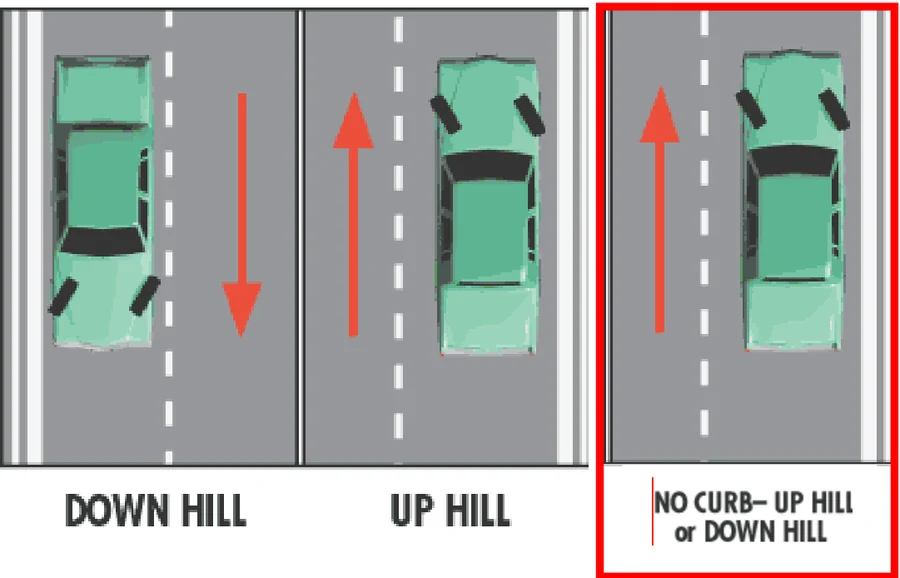
On a hill, turn your wheels sharply away from traffic so the car can't roll into traffic. By law, on a grade you must set the parking brake and turn the wheels to the curb or side of the highway.

Handbook p. 53 ↗
Parking on a hill (wheels)
Wheel positions: downhill, uphill, and no curb

Never park within…

Never park within…
DistanceOf
15 feetA fire hydrant
20 feetA crosswalk at an intersection
20 feetA fire station driveway on the same side
30 feetA traffic signal, stop sign or yield sign
30 feetA pedestrian safety zone
50 feetA railroad crossing
Handbook p. 54 ↗

Also never park:

  • In an intersection
  • On a crosswalk or on a sidewalk in a construction area if you block traffic
  • More than 18 inches from the curb
  • Blocking a driveway, alley, private road or a lowered curb for sidewalk access
  • On a bridge, overpass, tunnel or underpass
  • Along a lane of opposing traffic
  • In a handicapped zone without the proper tag
  • Next to another parked vehicle (double parking)
  • On railroad tracks, or where signs say no parking
Handbook p. 54 ↗

Know the rule

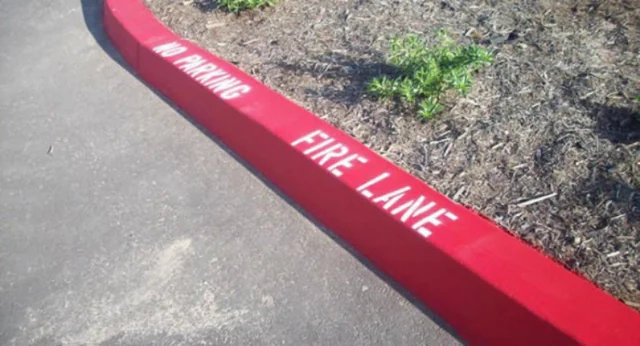
Painted curbs mark restricted zones: a red curb means fire zone; a yellow curb means a loading zone or other restriction.

Handbook p. 54 ↗
Red curb marking
Red curb: fire lane

Put it into practice

You find a spot 25 feet from a stop sign. It's illegal: you must be at least 30 feet from a stop sign. Move on and find a space that's also 15 feet or more from any hydrant.

Check your understanding

Read the question, decide on an answer, then open it to check the explanation. These are Roadwise study questions based on the source handbook.

When parallel parking, how far from the curb should your vehicle be?
  1. 6 inches or less
  2. 24 inches or less
  3. 18 inches or less
  4. 36 inches or less

Answer: 18 inches or less

When parallel parking, your vehicle should be no more than eighteen (18) inches from the curb.
Handbook p. 53 ↗
How close to a fire hydrant is it illegal to park?
  1. Within 10 feet
  2. Within 20 feet
  3. Within 25 feet
  4. Within 15 feet

Answer: Within 15 feet

Parking is prohibited within fifteen (15) feet of a fire hydrant.

Handbook p. 54 ↗
How close to a traffic signal, stop sign, or yield sign is it illegal to park?
  1. Within 15 feet
  2. Within 30 feet
  3. Within 20 feet
  4. Within 50 feet

Answer: Within 30 feet

Parking is prohibited within thirty (30) feet of a traffic signal, stop sign, or yield sign.

Handbook p. 54 ↗
How close to a railroad crossing is it illegal to park?
  1. Within 15 feet
  2. Within 30 feet
  3. Within 50 feet
  4. Within 100 feet

Answer: Within 50 feet

Parking is prohibited within fifty (50) feet of a railroad crossing.

Handbook p. 54 ↗
What does a red-painted curb mean?
  1. It marks a loading zone
  2. It marks a fire zone
  3. It marks visitor parking
  4. It marks handicapped parking

Answer: It marks a fire zone

A red curb indicates a fire zone where parking is restricted.

Handbook p. 54 ↗
When parking on a hill, which way should you turn your wheels?
  1. Straight ahead, regardless of the grade
  2. Toward oncoming traffic
  3. It doesn't matter, as long as the parking brake is set
  4. Sharply away from traffic, toward the curb or edge

Answer: Sharply away from traffic, toward the curb or edge

Turning the wheels away from traffic and toward the curb helps stop the car from rolling into traffic.

Handbook p. 53 ↗
Take the lesson checkpoint in the app

More in Lanes, Right-of-Way & Parking