roadwise.Open study app

Arkansas driving lesson · Lanes, Right-of-Way & Parking

Lane markings & lane use

A 3-minute lesson from the Arkansas course. Read the rules and examples, follow the handbook page references, and check your understanding before you move on.

Read time
3 minutes
Course unit
Lanes, Right-of-Way & Parking
Checkpoint questions
6
Source pages
43, 44

Lines on the pavement divide lanes, show when you may pass or change lanes, mark turn lanes, and show where to stop and where pedestrians cross. White lines separate traffic going your way; yellow lines separate traffic going the other way.

What the lines mean

What the lines mean
MarkingMeaning
Solid white edge line (fog line)Marks the outer edge of the roadway
Dashed white lineSame-direction lanes; cross to change lanes when safe
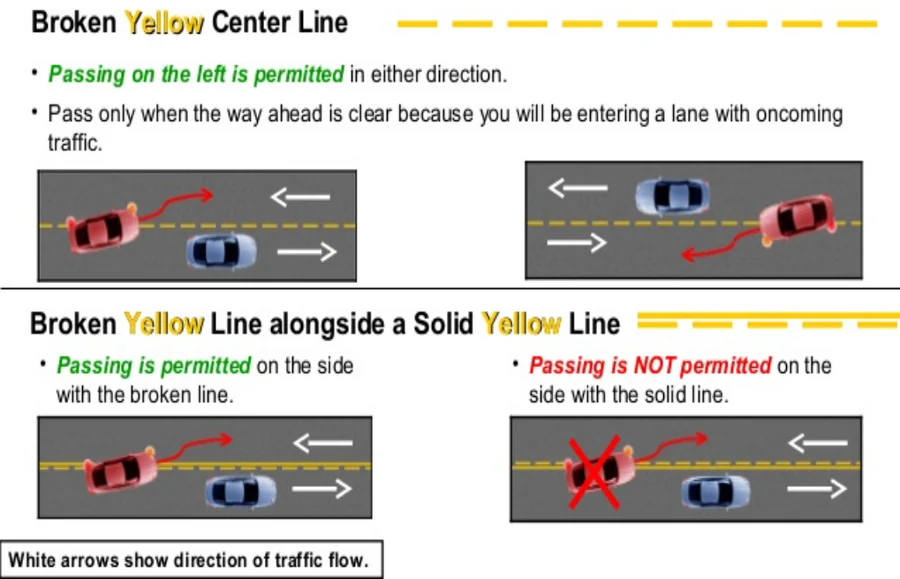
Broken yellow center lineYou may cross to pass if no opposing traffic
Solid yellow beside broken yellowPass only from the broken-line side
Double solid yellowNo passing in either direction
Handbook p. 43 ↗
Solid and broken yellow lines
Broken yellow center line vs. broken line alongside a solid line

Know the rule

You may cross a solid yellow line to turn into a driveway if no opposing traffic is approaching the spot where you'll turn.

Handbook p. 43 ↗

Know the rule

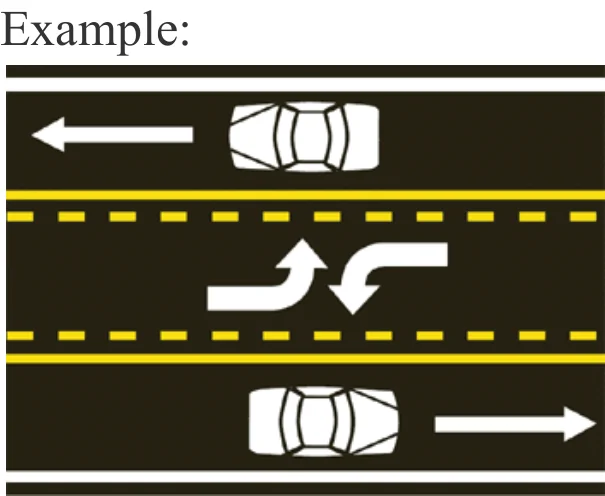
A shared center lane is reserved for left turns and may be used by vehicles traveling in either direction.

Handbook p. 44 ↗

Know the rule

In Arkansas, a vehicle turning left from a side street or driveway may use the center turn lane to gain access or merge into traffic, but may not use it as an acceleration lane.

Handbook p. 44 ↗
Two-way left turn lane markings
Shared center left-turn lane

Rules when lanes are unmarked:

  • Never back up in a travel lane; if you miss a turn or exit, go on to a safe turnaround
  • Never stop in a travel lane for any reason (confusion, breakdown, dropping off a passenger)
  • 3+ lanes one way: stay right except to pass; use the center lane if there's a lot of merging traffic
  • Never drive on the shoulder unless a police officer directs you to
Handbook p. 44 ↗

Know the rule

On multi-lane roads the leftmost lane is for passing slower vehicles. Never pass on the shoulder, paved or not; other drivers won't expect you there and may pull off without looking.

Handbook p. 44 ↗

Put it into practice

You're on a three-lane interstate and miss your exit. Don't stop or back up on the shoulder. Continue to the next exit or a safe turnaround and come back.

Check your understanding

Read the question, decide on an answer, then open it to check the explanation. These are Roadwise study questions based on the source handbook.

What does a broken yellow line between opposing lanes allow?
  1. Crossing to pass if there is no opposing traffic
  2. Passing at any time, no matter the oncoming traffic
  3. No passing under any condition
  4. Passing only on the right

Answer: Crossing to pass if there is no opposing traffic

A broken yellow line lets a driver cross to pass as long as no opposing traffic is present.
Handbook p. 43 ↗
According to the handbook, a solid double yellow line in the center of the road separates what?
  1. Lanes moving in the same direction
  2. Lanes moving in opposite directions
  3. A travel lane from the shoulder
  4. A travel lane from a shared turn lane

Answer: Lanes moving in opposite directions

A solid double yellow line separates lanes of traffic moving in opposite directions, and passing is prohibited both ways.

Handbook p. 43 ↗
What does a solid double yellow line mean?
  1. Passing is allowed if no oncoming traffic is visible
  2. Passing is allowed for slower vehicles only
  3. Passing is prohibited in both directions
  4. Passing is allowed only during daylight

Answer: Passing is prohibited in both directions

A solid double yellow line means passing is prohibited for vehicles traveling in either direction.

Handbook p. 43 ↗
In Arkansas, a shared center turn lane may be used for what?
  1. Merging into traffic after a left turn from a driveway or side street
  2. Accelerating before merging into a travel lane
  3. Passing slower vehicles
  4. Parking temporarily

Answer: Merging into traffic after a left turn from a driveway or side street

The center turn lane may be used to gain access or merge after a left turn, but never as an acceleration lane.

Handbook p. 44 ↗
On a road with three or more lanes in the same direction and no heavy merging, which lane should you generally use?
  1. The left lane
  2. The right lane
  3. The center lane only
  4. Any lane you prefer

Answer: The right lane

Drivers should stay in the right lane except to pass, unless heavy merging traffic calls for the center lane.

Handbook p. 44 ↗
It is legal to use a shared center turn lane as an acceleration lane in Arkansas.
  1. True
  2. False

Answer: False

The center turn lane may be used to merge after a left turn, but never as an acceleration lane.

Handbook p. 44 ↗
Take the lesson checkpoint in the app

More in Lanes, Right-of-Way & Parking