A 3-minute lesson from the Arizona course. Read the rules and examples, follow the handbook page references, and check your understanding before you move on.
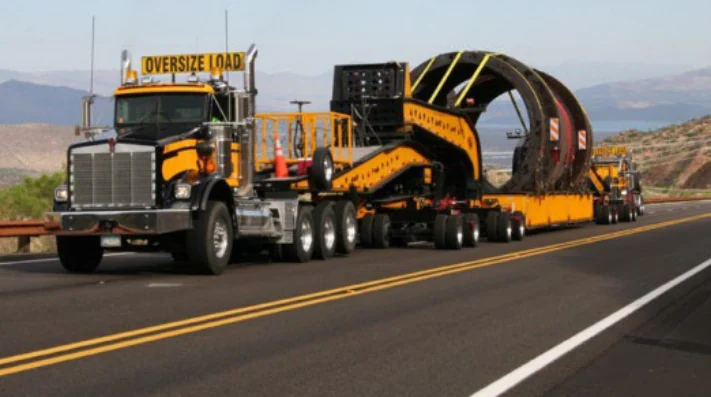
Large trucks need more room to stop, see less around them, and swing wide to turn. Farm machinery and other slow-moving vehicles have every legal right to be on the road. Sharing the road with both means patience and space.
Five ways to share the road with trucks:
Don't cut in front — trucks take twice as long to stop; cutting in halves their stopping room
Stay out of the "No-Zone": large blind spots around the front and back sides of trucks and buses
Follow at a safe distance — trucks are almost as wide as some lanes
Watch truck turn signals — trucks make wide right turns and may leave space on the right
If you break down, pull off the highway as far as you can
Farm machinery usually travels at 25 mph or less, may take up more than one lane, and may not have signals. Keep a following distance that gives you a good field of vision.
The slow-moving vehicle emblem warns you to slow down. A vehicle displaying it cannot travel faster than 25 mph and has the legal right to be on the road.
A tractor ahead drifts left toward the center line. Don't pass on the right — it may be swinging left to make a wide right turn. Hang back until its move is clear.
Check your understanding
Read the question, decide on an answer, then open it to check the explanation. These are Roadwise study questions based on the source handbook.
Why shouldn't you cut in front of a large truck?
Trucks always have the right-of-way
Trucks take twice as long to stop
Trucks can't see vehicles behind them
It is only a courtesy rule
Answer: Trucks take twice as long to stop
Trucks take about twice as long to stop, so cutting in front and braking suddenly cuts their stopping distance dangerously.