roadwise.Open study app

Alaska driving lesson · Distraction, Control & Fatigue

Vehicle control, due care & backing

A 3-minute lesson from the Alaska course. Read the rules and examples, follow the handbook page references, and check your understanding before you move on.

Read time
3 minutes
Course unit
Distraction, Control & Fatigue
Checkpoint questions
6
Source pages
30, 31, 79

More fatal crashes happen in daylight, on a normal surface, in clear weather, in a sound vehicle than under any other condition. The driver is the greatest single cause of crashes, so control starts with you.

Control of your vehicle

Being able to direct and regulate your vehicle's course and speed, and to slow or stop whenever you choose.

Handbook p. 30 ↗

Know the rule

You must control yourself before you can control a vehicle. Insufficient sleep, emotions, and distractions all impair your ability to control it safely.

Handbook p. 30 ↗

Know the rule

Every driver must use care to avoid crashes with pedestrians (people walking or riding a bicycle), animals, or other vehicles, must be able to stop, and must slow down when circumstances require.

Handbook p. 30 ↗
Hazards to watch for while driving
Situations that call for extra care

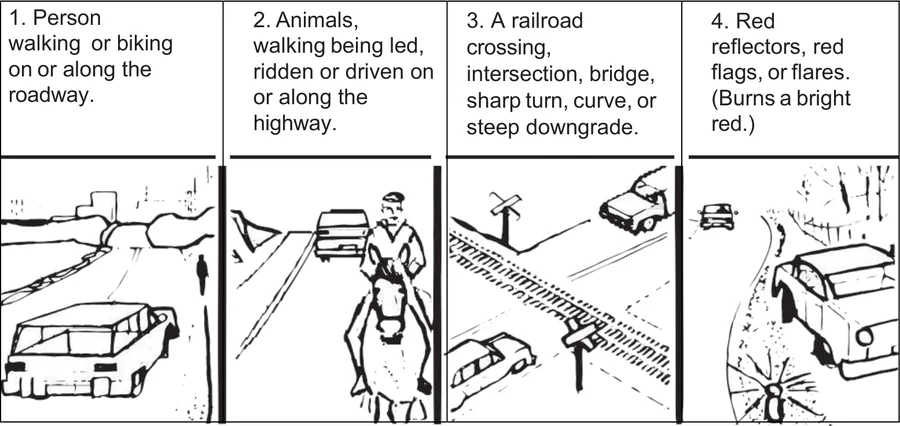
Slow down and be ready to stop for:

  • People walking or biking on or along the roadway
  • Animals walking, being led, ridden, or driven on or along the highway
  • A railroad crossing, intersection, bridge, sharp turn, curve, or steep downgrade
  • Red reflectors, red flags, or flares (flares burn bright red)
  • Orange flags and signs, which mark a "high hazard area" (maintenance and construction)
Handbook p. 31 ↗

How to back up:

  • Don't depend on mirrors
  • Put your left hand at the top of the wheel, turn your body and head right, and look out the rear window
  • Turn the wheel in the direction you want the REAR of the vehicle to go
  • Back slowly, keep your eyes moving to all sides, and be prepared to stop
  • Yield to vehicles and people on the street or sidewalk
Handbook p. 31 ↗
5 mph

Suggested maximum speed when backing

Handbook p. 31 ↗

Know the rule

When backing, you must yield to any vehicle approaching on the highway or an intersecting highway. Don't open the door and stick your head out to see.

Handbook p. 79 ↗

Know the rule

Backing on a controlled-access highway or its ramps is illegal unless police, fire, or construction flag personnel direct you to.

Handbook p. 79 ↗

Know the rule

You may not drive with more people in the front seat than it was designed for, or with objects that interfere with your control of the vehicle or your view.

Handbook p. 31 ↗

Put it into practice

You're backing out of a driveway onto a residential street. Turn and look out the rear window instead of relying on mirrors, creep back at no more than about 5 mph, and stop for the jogger coming along the sidewalk.

Check your understanding

Read the question, decide on an answer, then open it to check the explanation. These are Roadwise study questions based on the source handbook.

What is considered a suggested safe speed when backing up your vehicle?
  1. Not exceeding 15 mph
  2. Not exceeding 5 mph
  3. Not exceeding 10 mph
  4. There is no suggested speed limit

Answer: Not exceeding 5 mph

The handbook suggests a backing speed not exceeding 5 mph.
Handbook p. 31 ↗
When backing up, what should you do instead of relying only on mirrors?
  1. Use only the rearview mirror
  2. Open the door and look back
  3. Turn your body and head to look out the rear window
  4. Watch the backup camera only

Answer: Turn your body and head to look out the rear window

Turn your body and head to look out the rear window rather than depending on mirrors.

Handbook p. 31 ↗
What does Alaska law say about objects that interfere with a driver's control or view?
  1. They are allowed if on the passenger side
  2. They are allowed on short trips
  3. They are only banned on highways
  4. A person may not drive with such an obstruction

Answer: A person may not drive with such an obstruction

Driving with objects that interfere with control or view of the vehicle is prohibited.

Handbook p. 31 ↗
Which best describes 'control of a vehicle' as defined in the handbook?
  1. Being able to direct, regulate, and stop your vehicle as needed
  2. Driving at or above the posted speed limit
  3. Keeping both hands on the wheel at all times
  4. Using cruise control on the highway

Answer: Being able to direct, regulate, and stop your vehicle as needed

Control means being able to direct, regulate the course and speed, and stop your vehicle.

Handbook p. 30 ↗
According to the handbook, what is the greatest single cause of traffic crashes?
  1. Poor road design
  2. The driver
  3. Vehicle defects
  4. Weather conditions

Answer: The driver

The handbook identifies the driver as the greatest singular cause of traffic crashes.

Handbook p. 30 ↗
Most fatal crashes occur under which conditions, according to the handbook?
  1. Nighttime, icy roads, heavy fog
  2. Daylight, normal road surface, clear weather
  3. Dawn, wet roads, high wind
  4. Midnight, snow, poor visibility

Answer: Daylight, normal road surface, clear weather

More fatal crashes occur during daylight, normal road surface, and clear weather than any other condition.

Handbook p. 30 ↗
Take the lesson checkpoint in the app

More in Distraction, Control & Fatigue