roadwise.Open study app

Alaska driving lesson · Parking, Equipment & Maintenance

Parallel parking, hills & pulling out

A 3-minute lesson from the Alaska course. Read the rules and examples, follow the handbook page references, and check your understanding before you move on.

Read time
3 minutes
Course unit
Parking, Equipment & Maintenance
Checkpoint questions
6
Source pages
74, 75

Parallel parking is a skill you'll be tested on, and parking on a hill means turning your wheels so the car can't roll into traffic. When you pull out, the burden of avoiding a crash is on you.

Parallel parking steps
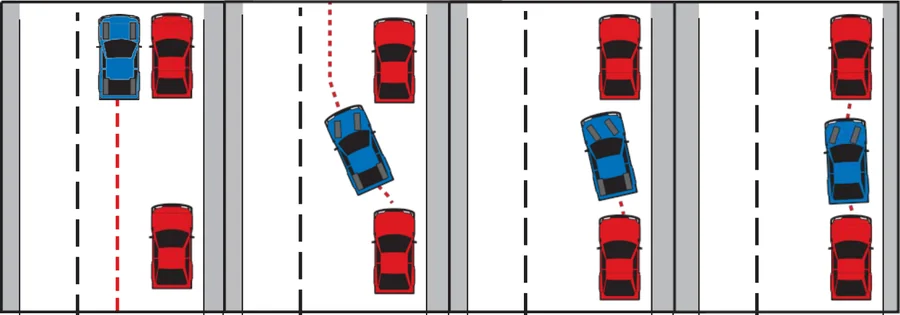
Parallel parking, steps 1-4

Parallel parking:

  • Signal and stop even with the front vehicle, about a foot and a half out, rear bumpers even
  • Back slowly, turning the wheel sharply right until you're at about a 45-degree angle
  • Quickly straighten the front wheels and keep backing slowly
  • When your front bumper is even with its back bumper, turn sharply left as far as possible
  • Back slowly to the car behind without touching it
  • Turn the wheel sharply right, pull forward toward the curb, and center the car
Handbook p. 74 ↗
12 inches

When parallel parked, your wheels must be within this distance of the curb

Handbook p. 74 ↗
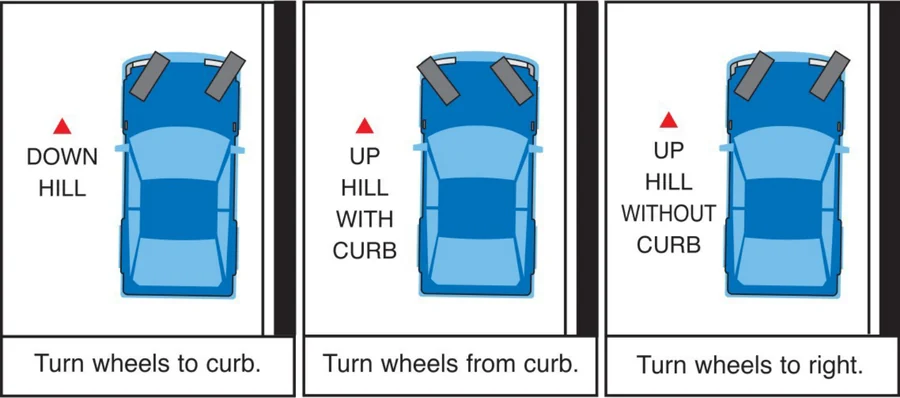
Parking on a hill
Parking on a hill: which way to turn your wheels

Parking on a hill

Parking on a hill
SituationTurn front wheels
DownhillToward the curb
Uphill with a curbAway from the curb
Uphill without a curbTo the right
Handbook p. 75 ↗

Know the rule

Before moving out of a parking place, look, signal, and yield the right-of-way.

Handbook p. 74 ↗

Know the rule

The driver leaving a parking space has the chief responsibility for avoiding a collision.

Handbook p. 75 ↗

Know the rule

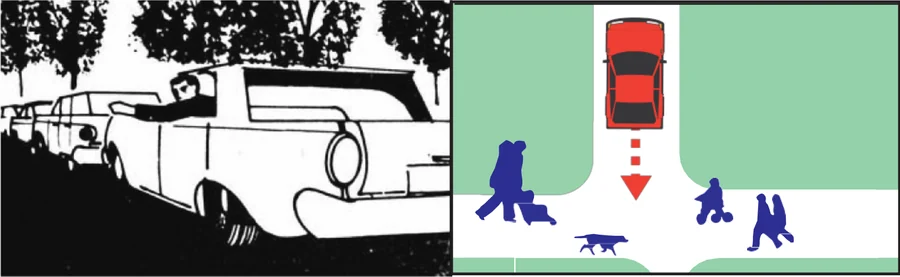
Use extraordinary caution when backing up in residential areas; children may be behind and between parked vehicles.

Handbook p. 75 ↗
Leaving a parking space
Look back before driving away from the curb

Put it into practice

You're parked facing uphill on a street with a curb. Turn your front wheels away from the curb, so if the car rolls back the tire stops against it. Facing downhill, you'd turn them toward the curb.

Check your understanding

Read the question, decide on an answer, then open it to check the explanation. These are Roadwise study questions based on the source handbook.

When parallel parking, how close to the curb must your wheels be?
  1. Within 24 inches
  2. Within 6 inches
  3. Within 12 inches
  4. Within 36 inches

Answer: Within 12 inches

Parallel-parked wheels must be within 12 inches of the curb.
Handbook p. 74 ↗
When parking downhill, which direction should you turn your front wheels?
  1. Away from the curb
  2. Straight ahead
  3. It does not matter
  4. Toward the curb

Answer: Toward the curb

Turn your wheels toward the curb when parked facing downhill.

Handbook p. 74 ↗
When parking uphill next to a curb, which direction should you turn your front wheels?
  1. Away from the curb
  2. Toward the curb
  3. Straight ahead
  4. It does not matter if the brake is set

Answer: Away from the curb

Turn your wheels away from the curb when parked facing uphill.

Handbook p. 74 ↗
What must a driver do before moving out of a parking space?
  1. Only check the rearview mirror
  2. Look, signal, and yield the right-of-way
  3. Only signal, since other drivers should watch for you
  4. Honk before pulling out

Answer: Look, signal, and yield the right-of-way

The driver must look, signal, and yield when moving out of a parking space.

Handbook p. 74 ↗
Who has the chief responsibility for avoiding a collision when leaving a parking space?
  1. The driver of the nearest moving vehicle
  2. Any pedestrian nearby
  3. The driver leaving the parking space
  4. Whoever arrives at the space first

Answer: The driver leaving the parking space

The chief responsibility for avoiding a collision lies with the driver leaving the space.

Handbook p. 75 ↗
Why should drivers use extra caution backing up in residential areas?
  1. Residential streets are always narrower
  2. It is required only near schools
  3. Curbs in residential areas are higher
  4. Children may be present behind or between parked vehicles

Answer: Children may be present behind or between parked vehicles

Children may be behind or between parked vehicles in residential areas, requiring extra caution.

Handbook p. 75 ↗
Take the lesson checkpoint in the app

More in Parking, Equipment & Maintenance