roadwise.Open study app

Alabama driving lesson · Driving the Freeways

Entering the freeway and interchanges

A 3-minute lesson from the Alabama course. Read the rules and examples, follow the handbook page references, and check your understanding before you move on.

Read time
3 minutes
Course unit
Driving the Freeways
Checkpoint questions
6
Source pages
78, 79, 80

Freeways let you drive long distances without stops or cross traffic, with less fatigue and more safety. Using them well means keeping pace, staying alert and merging smoothly.

Freeway

A multi-lane, controlled-access, divided highway with no stops and no cross traffic.

Handbook p. 78 ↗

Know the rule

Slower vehicles, those going less than the normal speed of traffic at the time, MUST KEEP TO THE RIGHT.

Handbook p. 78 ↗

Know the rule

Cutting from lane to lane is dangerous. Choose the lane moving at the pace you prefer and stay in it. To change lanes, check traffic carefully and signal well in advance.

Handbook p. 78 ↗
Entering the freeway
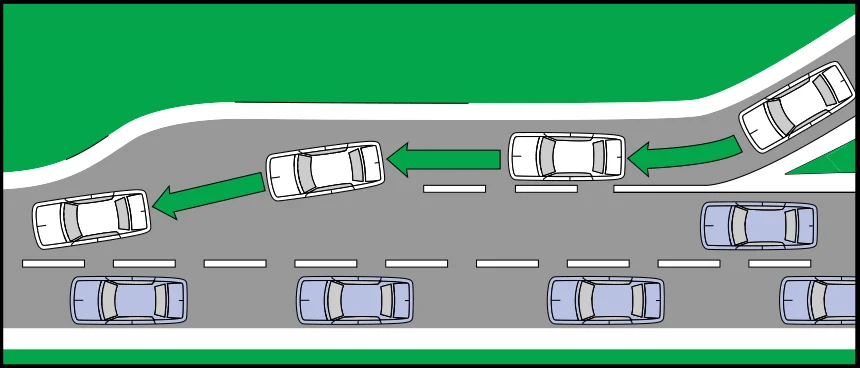
Entering a freeway: the ramp leads to an acceleration lane

Entering the freeway:

  • Take the short, one-way entrance ramp to the acceleration lane
  • Speed up to match the traffic in the through lanes, if possible
  • Watch for an opening, turn on your signal and merge smoothly
Handbook p. 78 ↗

Know the rule

Freeway drivers should make room for entering traffic, but if they don't, you must yield to them. Don't stop in the acceleration lane unless absolutely necessary.

Handbook p. 78 ↗

Know the rule

Where an entrance ramp has a YIELD sign and no acceleration lane, entering traffic must obey it and stop if necessary rather than force its way in.

Handbook p. 79 ↗

Interchange

Where two highways cross at different levels, with separate connecting roads to transfer traffic between them without interfering with other vehicles.

Handbook p. 79 ↗
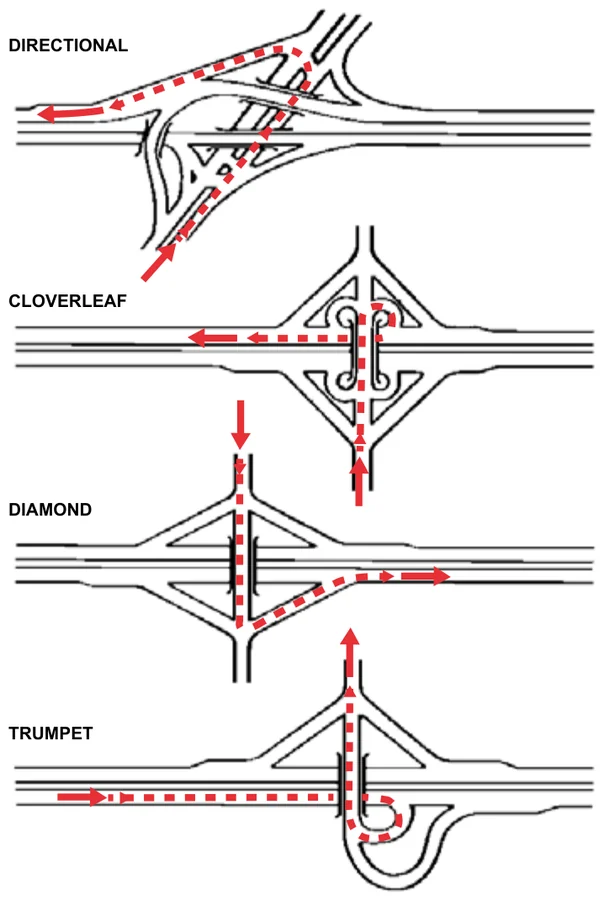
Types of freeway interchanges
Directional, cloverleaf, diamond and trumpet interchanges

Common interchange types

Common interchange types
TypeKey feature
DirectionalHeavy traffic between only two legs of the interchange
CloverleafLoops for all 4 directions; no left-turn/cross conflicts
DiamondFour ramps; left turns made AFTER leaving the freeway
TrumpetAnother road meets the freeway in a "T"
Handbook p. 79 ↗

Put it into practice

You're on a short ramp with a YIELD sign and no acceleration lane, and the right freeway lane is full. Slow down and stop if you must. Wait for a safe gap instead of forcing your way into traffic.

Check your understanding

Read the question, decide on an answer, then open it to check the explanation. These are Roadwise study questions based on the source handbook.

Slower-moving vehicles on a freeway must generally do what?
  1. Keep to the left
  2. Use the shoulder
  3. Use the passing lane only
  4. Keep to the right

Answer: Keep to the right

Vehicles traveling slower than the normal traffic pace must keep to the right on a freeway.
Handbook p. 78 ↗
When entering a freeway from an acceleration lane, what should you do?
  1. Speed up to match through traffic, then merge
  2. Merge first, then speed up
  3. Come to a full stop before merging
  4. Merge immediately at a low speed

Answer: Speed up to match through traffic, then merge

As you enter the acceleration lane, you should speed up to match the through-lane traffic before merging.

Handbook p. 78 ↗
When should you come to a full stop in a freeway acceleration lane?
  1. Whenever entering traffic is heavy
  2. Only if absolutely necessary
  3. Never, it is always illegal
  4. Every time, as a safety precaution

Answer: Only if absolutely necessary

The handbook instructs drivers not to come to a full stop in the acceleration lane unless absolutely necessary.

Handbook p. 79 ↗
If an entrance ramp has a YIELD sign and no acceleration lane, what must entering traffic do?
  1. Merge at speed without stopping
  2. Ignore the sign if the ramp is empty
  3. Obey the YIELD sign; stop if needed
  4. Always come to a complete stop

Answer: Obey the YIELD sign; stop if needed

Where a YIELD sign is posted with no acceleration lane, entering traffic must obey it and stop if necessary.

Handbook p. 79 ↗
Which interchange type uses loop connections to eliminate left-turn and cross-traffic conflicts from all four directions?
  1. Cloverleaf interchange
  2. Directional interchange
  3. Diamond interchange
  4. Trumpet interchange

Answer: Cloverleaf interchange

A cloverleaf interchange uses loop connections to allow turning movements from four directions while eliminating left-turn conflicts.

Handbook p. 79 ↗
In a diamond interchange, when are left turns typically made?
  1. While still on the freeway
  2. After leaving the freeway
  3. Never; diamond interchanges prohibit left turns
  4. Only using a loop ramp

Answer: After leaving the freeway

A diamond interchange is characterized by four ramps, with left turns made after leaving the freeway.

Handbook p. 80 ↗
Take the lesson checkpoint in the app

More in Driving the Freeways