roadwise.Open study app

Vermont driving lesson · Getting Your Vermont License

Road test maneuvers

A 4-minute lesson from the Vermont course. Read the rules and examples, follow the handbook page references, and check your understanding before you move on.

Read time
4 minutes
Course unit
Getting Your Vermont License
Checkpoint questions
5
Source pages
57, 58, 59

On the road test the examiner watches whether you drive safely, courteously and correctly, and follow the rules of the road. You will be asked to do three set maneuvers: a stop and start on a hill, a turnaround using a side street, and parallel parking.

Hill stop and start:

  • Signal right, drive to the right side of the road and stop
  • Set the parking brake and shift to neutral; the brake must keep the car from rolling back
  • Put the car in gear, signal left, check mirrors and your left blind spot
  • Accelerate gently; release the parking brake (if it doesn't release itself)
  • Look over your left shoulder again and drive up the hill without rolling back
Handbook p. 57 ↗

Know the rule

Some vehicles have hill assist or a parking brake that releases automatically when you press the gas. Do the hill start the way your vehicle is meant to.

Handbook p. 57 ↗

To avoid rolling back when starting on a hill:

  • Quickly move your foot from the brake to the gas, or
  • Set the parking brake, move your right foot to the gas, apply gas lightly and carefully release the brake
Handbook p. 57 ↗

Know the rule

When driving downhill, don't coast with the clutch pressed to the floor or the gearshift in neutral.

Handbook p. 57 ↗

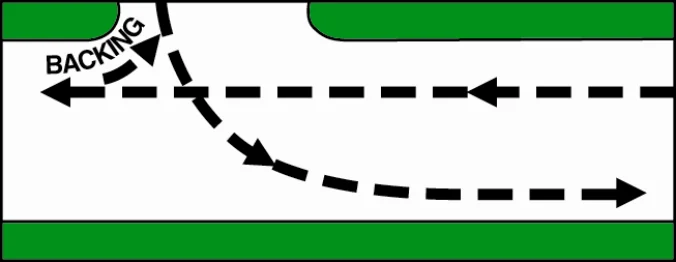
Turnaround using a side street on your right:

  • Slow down, check traffic in all directions and signal
  • Drive just past the street and stop about 18 inches from the curb or road edge
  • Shift to reverse, check all directions and your blind spots
  • Back slowly into the side street on your own side, looking mostly through the rear window
  • Stop when fully in the side street, beyond any crosswalk or stop line
  • Signal left, shift to drive, and make a proper left turn out when no vehicles are coming
Handbook p. 57 ↗
Backing into a side street
Backing into a side street to turn around

Know the rule

Never back across an intersection. When you back up, you are responsible for traffic in all directions.

Handbook p. 58 ↗

Know the rule

Going around the block or using a parking lot is the safest way to turn around.

Handbook p. 58 ↗

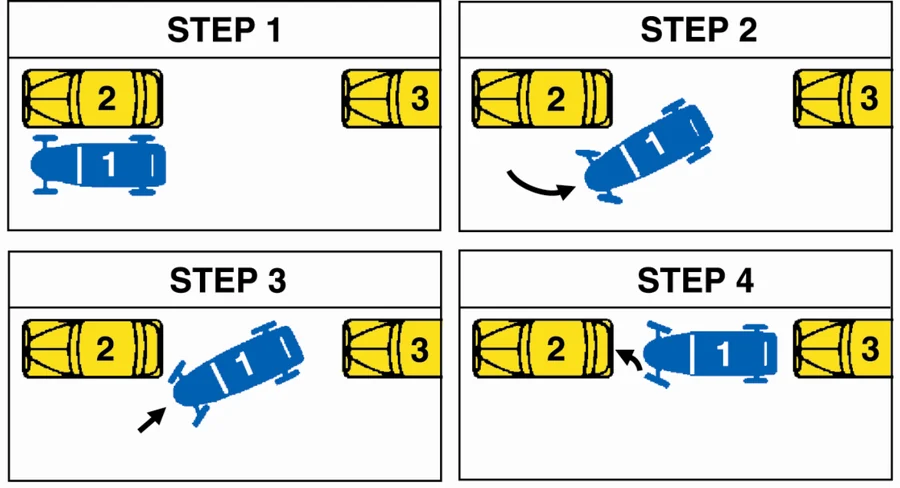
Parallel parking: entering the space

  • Check your rearview mirror and signal right
  • Stop alongside the front vehicle, two to three feet away
  • Shift to reverse; check traffic and pedestrians, and look over your left shoulder
  • Back slowly, steering fully right then fully left, looking through the rear window
  • Pull forward slowly to center the vehicle in the space
Handbook p. 58 ↗
Parallel parking (steps 1-4)
Parallel parking, steps 1 to 4

Leaving the space:

  • If needed, back up so you can re-enter traffic in one motion
  • Signal left and check mirrors and over your left shoulder for vehicles, bicyclists and pedestrians
  • When clear, pull out slowly and stay on your own side
Handbook p. 58 ↗

Know the rule

On the road test you may have to parallel park with only a front vehicle. Follow the same steps.

Handbook p. 59 ↗

Put it into practice

The examiner asks you to turn around. You pass the side street on your right, stop about 18 inches from the curb, check every direction, and back in slowly while looking through the rear window. You stop past the crosswalk, signal left, and pull out with a proper left turn.

Check your understanding

Read the question, decide on an answer, then open it to check the explanation. These are Roadwise study questions based on the source handbook.

On the road test turnaround, how far from the curb should you stop just past the side street before backing?
  1. About 18 inches
  2. About 12 inches
  3. Two to three feet
  4. About 6 inches

Answer: About 18 inches

Drive just past the street and stop about 18 inches from the curb or edge of the road, then shift into reverse.
Handbook p. 57 ↗
When starting to parallel park, how far from the front vehicle should you stop alongside it?
  1. About 18 inches
  2. Two to three feet
  3. Four to five feet
  4. Within 12 inches

Answer: Two to three feet

Stop alongside the front vehicle, two to three feet away, before shifting to reverse.

Handbook p. 58 ↗
During the road test hill stop, after signaling and stopping at the right side, what are you told to do next?
  1. Turn the wheels to the curb and shut off the engine
  2. Keep your foot on the brake with the car in drive
  3. Set the parking brake and shift to neutral
  4. Shift to reverse and set the parking brake

Answer: Set the parking brake and shift to neutral

You stop, set the parking/emergency brake and shift to neutral; the brake must keep the vehicle from rolling back.

Handbook p. 57 ↗
According to the handbook, what is the safest way to turn your vehicle around?
  1. Backing into a side street on your left
  2. Going around the block or using a parking lot
  3. A three-point turn in the middle of the block
  4. A U-turn at the next intersection

Answer: Going around the block or using a parking lot

Several turnaround options exist, but going around the block or using a parking lot is the safest.

Handbook p. 58 ↗
When driving downhill, it is acceptable to coast with the gearshift in neutral.
  1. True
  2. False

Answer: False

The handbook says not to coast downhill with the clutch to the floor or the gearshift in neutral.

Handbook p. 57 ↗
Take the lesson checkpoint in the app

More in Getting Your Vermont License