roadwise.Open study app

Oregon driving lesson · Parking & Stopping

How to Park

A 3-minute lesson from the Oregon course. Read the rules and examples, follow the handbook page references, and check your understanding before you move on.

Read time
3 minutes
Course unit
Parking & Stopping
Checkpoint questions
6
Source pages
76, 77, 78

Parking well means ending up close to the curb, inside the lines, and secured so the car can't roll. On hills, the direction you turn your wheels decides whether a failed brake sends the car into the curb or into traffic.

Know the rule

When leaving a parked or stopped position, check your blind spots and mirrors, and yield to all other traffic.

Handbook p. 76 ↗

Parallel parking rules

  • Park in the direction vehicles are moving in that lane
  • Park parallel to the curb and no more than 12 inches from it
  • No curb? Park as close as possible to the edge of the shoulder
  • If spaces are marked, your wheels must be within the marked space
Handbook p. 76 ↗
12 inches

Maximum distance from the curb when parallel parked

Handbook p. 76 ↗

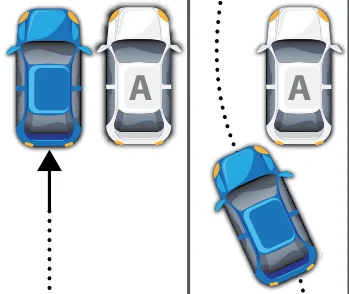
Parallel parking steps

  • 1. Pull even with the car ahead of the space (Car A)
  • 2. Back slowly toward the space, turning your wheels sharply
  • 3. Straighten your wheels
Handbook p. 76 ↗
Entering an angle parking space
Parallel parking

Know the rule

Angle parking is common in parking lots, shopping centers and on wide streets. In a large vehicle, avoid spaces where you'd obstruct traffic on the road. Signs may mark reverse-angle or back-in-only parking.

Handbook p. 76 ↗

Know the rule

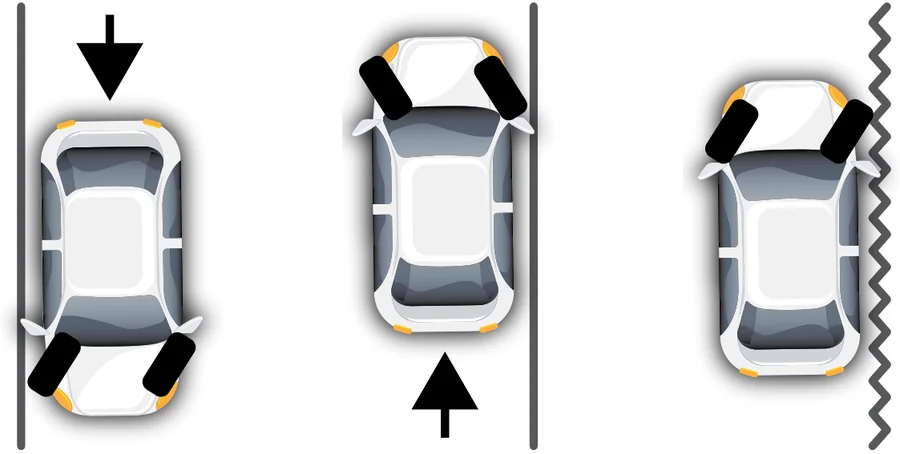
On any hill, always set your parking brake, and leave the vehicle in gear (manual transmission) or in park (automatic).

Handbook p. 77 ↗

Which way to turn your front wheels on a hill

Which way to turn your front wheels on a hill
SituationTurn wheels
Downhill, against a curbToward the curb
Uphill, against a curbToward the travel lane
No curb (uphill or downhill)Toward the edge of the road
Handbook p. 77 ↗
Turning wheels at a curb
Wheel positions: downhill curb, uphill curb, no curb

Know the rule

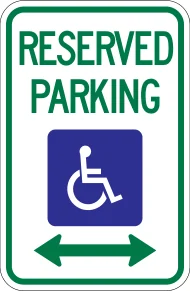
It's illegal to park in a space marked for persons with disabilities without a valid disabled parking permit. Spaces may show the symbol on the ground and on a sign at the front of the space.

Handbook p. 77 ↗
$165 to $1,000

Fines for parking in a disabled person space without a permit — even for “just a few minutes”

Handbook p. 78 ↗
Reserved parking (accessible)
Reserved parking sign

Put it into practice

You park facing uphill on a street with a curb, in a car with an automatic transmission. Set the parking brake, shift into park and turn your front wheels toward the travel lane, to keep the car from rolling downhill if the brake fails.

Check your understanding

Read the question, decide on an answer, then open it to check the explanation. These are Roadwise study questions based on the source handbook.

When parallel parking, your vehicle must be no more than how many inches from the curb?
  1. 6 inches
  2. 12 inches
  3. 18 inches
  4. 24 inches

Answer: 12 inches

Parallel parking must be within 12 inches of the curb.
Handbook p. 76 ↗
Parking downhill against a curb, you should turn your front wheels:
  1. Toward the travel lane
  2. Straight ahead
  3. Toward the curb
  4. Either way, if the brake is set

Answer: Toward the curb

Wheels toward the curb prevent rolling downhill into traffic.

Handbook p. 77 ↗
Parking uphill against a curb, you should turn your front wheels:
  1. Toward the curb
  2. Straight ahead, never angled
  3. In either direction, it doesn't matter
  4. Toward the travel lane

Answer: Toward the travel lane

Wheels toward the travel lane let the curb stop the vehicle.

Handbook p. 77 ↗
If there is no curb, when parking on a hill you should turn your wheels:
  1. Toward the edge of the road
  2. Toward the center of the road
  3. Straight, parallel to the road
  4. It does not matter without a curb

Answer: Toward the edge of the road

With no curb, turn wheels toward the road's edge.

Handbook p. 77 ↗
Fines for parking in a space reserved for persons with disabilities without a valid permit can reach up to:
  1. $165
  2. $500
  3. $1,000
  4. $2,500

Answer: $1,000

Fines begin at $165 and go up to $1,000 if you are not a Disabled Person Parking Permit holder.

Handbook p. 78 ↗
If parking spaces are marked with painted lines, your wheels must be:
  1. Within the marked space
  2. Centered over the line
  3. At least 12 inches from each line
  4. Touching the front line

Answer: Within the marked space

Your wheels must stay within the marked space.

Handbook p. 76 ↗
Take the lesson checkpoint in the app

More in Parking & Stopping