Roadwise States Oklahoma Driving lessons Floods and what to do after a crash Oklahoma driving lesson · Driving Tips and Emergencies
Floods and what to do after a crash A 3-minute lesson from the Oklahoma course. Read the rules and examples, follow the handbook page references, and check your understanding before you move on.
Read time 3 minutes
Course unit Driving Tips and Emergencies
Checkpoint questions 6
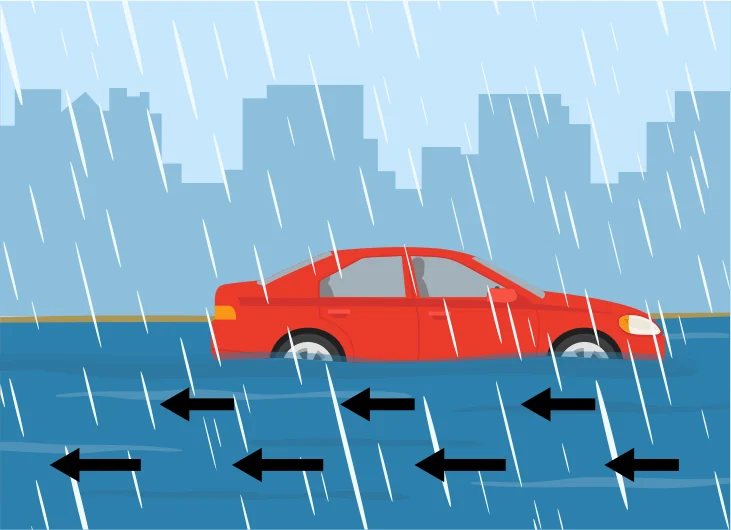
Source pages 62, 63 Moving water is far stronger than it looks, and a car becomes buoyant fast. Most vehicles will float in just 2 feet of water, even SUVs. If you meet a flooded road: Turn Around, Don't Drown.
A car swept along by floodwater Flood safety rules: Cars can easily stall in water and be carried away in any current Most vehicles will be swept away by less than 2 feet (24 inches) of running water Don't try to cross a flooded road or stream, or drive into flowing water Don't drive around barricades at low-water crossings Be especially vigilant at night or on unfamiliar roads Remember roadbeds beneath the water may have been washed away Handbook p. 62 ↗ 6 inches Water that may make you lose control of your vehicle, and fast-moving water that can knock you off your feet
Handbook p. 63 ↗ Know the rule
Observe water level indicators at low-water crossings. If you abandon your vehicle, respect the force of the water.
Handbook p. 63 ↗ If you're in a collision that results in death, injury or property damage, stay calm and follow the steps below.
After a crash: Stop and call 911 or local law enforcement Turn on hazard lights Get help for anyone hurt, but DON'T move an injured person unless it's a life-or-death necessity If the crash is minor and your vehicle blocks traffic, move it or have it moved Exchange vehicle, witness and driver information (name, address, phone, license, registration, insurance) Take photos Don't blame others, accept blame or discuss the accident; answer officers truthfully and calmly Handbook p. 63 ↗ Know the rule
If you hit a parked car or property and can't find the owner, leave the driver's and owner's name and address and your insurance verification information where the owner will find it.
Handbook p. 63 ↗ Know the rule
The investigating officer completes a report. Contact your insurance company as soon as possible to report the accident.
Handbook p. 63 ↗ Put it into practice
After a minor fender bender in a busy lane, no one is hurt. Call police, turn on your hazards and move the cars out of traffic. Exchange information and take photos. Don't argue over fault; tell the officer calmly what happened.
Check your understanding Read the question, decide on an answer, then open it to check the explanation. These are Roadwise study questions based on the source handbook.
About how much water can make most vehicles float away? 2 feet (24 inches) 6 inches 4 feet 1 foot Answer: 2 feet (24 inches)
Most vehicles, even SUVs, will float in about 2 feet of water.
Handbook p. 62 ↗ What is the first thing you should do after a crash involving injury? Stop and call 911 Move all vehicles immediately Exchange insurance information first Take photos before anything else Answer: Stop and call 911
Stop and call 911 or local law enforcement first.
Handbook p. 63 ↗ Should you move an injured person after a crash? Yes, always move them to the roadside No, unless life-or-death Only if you're a medical professional Yes, to make room for other traffic Answer: No, unless life-or-death
Do not move an injured person unless it's a life-or-death necessity.
Handbook p. 63 ↗ If you encounter a flooded roadway, you should turn around instead of driving through it. True False Answer: True
Turn Around, Don't Drown is the rule for flooded roadways.
Handbook p. 63 ↗ About how much lateral force does floodwater apply to a stalled car for each foot it rises? About 100 pounds About 500 pounds About 2,000 pounds About 50 pounds Answer: About 500 pounds
For each foot the water rises, about 500 pounds of lateral force is applied to the car.
Handbook p. 62 ↗ After a minor crash where your car is blocking traffic, what should you do? Leave it where it stopped until police arrive Wait for a tow truck before moving it Move it out of the way if you're able to Leave it but turn off the engine Answer: Move it out of the way if you're able to
If a crash is minor and your vehicle blocks traffic, you must move it or have it moved.
Handbook p. 63 ↗ Previous lesson Distracted driving and animals Next lesson How alcohol and drugs affect your driving More in Driving Tips and Emergencies About the source Roadwise’s Oklahoma course uses the driver handbook edition supplied with this study pack. This lesson cites source pages 62, 63. The linked PDF is a third-party mirror of the handbook, rather than a government-hosted page.
Open the handbook source PDF · View the source edition
For current application requirements, fees, appointments, and the format that applies to your age or license type, check Oklahoma’s Service Oklahoma. Roadwise provides study material and does not issue permits or licenses.