roadwise.Open study app

Missouri driving lesson · Parking

Parking safely, on hills and parallel

A 3-minute lesson from the Missouri course. Read the rules and examples, follow the handbook page references, and check your understanding before you move on.

Read time
3 minutes
Course unit
Parking
Checkpoint questions
6
Source pages
37, 38

A parked car must never become a hazard. Park far enough from travel lanes that you don't interfere with traffic, where drivers from either direction can see you. Then secure the vehicle and get out carefully.

Every time you park:

  • Park in a designated area if possible
  • Set the parking brake; leave it in gear (manual) or park (automatic)
  • Check traffic before opening the door, and get out on the curb side if you can
  • Have passengers, especially children, exit on the curb side; watch for bicyclists near parked cars
  • Never leave the keys in the vehicle; lock it whenever it will be out of your sight
  • On a roadway, park as far from traffic as possible, as close to the curb as you can
Handbook p. 37 ↗

Know the rule

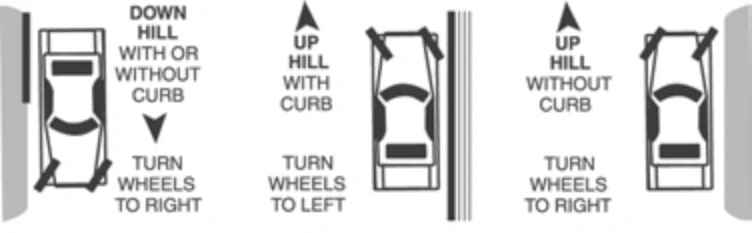
When you park on a hill, turn your wheels sharply toward the side of the road so that if the vehicle rolls, it rolls away from traffic.

Handbook p. 37 ↗

Wheel direction when parking on a hill

Wheel direction when parking on a hill
SituationTurn your wheels
Downhill, with or without a curbTo the right
Uphill with a curbTo the left
Uphill without a curbTo the right
Handbook p. 38 ↗
Parking on a hill wheel positions (all scenarios)
Wheel positions for parking downhill and uphill

Before leaving a vehicle parked on a hill:

  • Turn your wheels in the proper direction
  • Turn off the motor, leaving the vehicle in the proper gear
  • Set the emergency or parking brake
  • Remove the keys from the ignition
  • Check your rearview mirror for traffic before stepping out
  • Lock it and pocket the keys
Handbook p. 38 ↗

Know the rule

Before you drive away from any parking space, check for traffic and signal.

Handbook p. 38 ↗

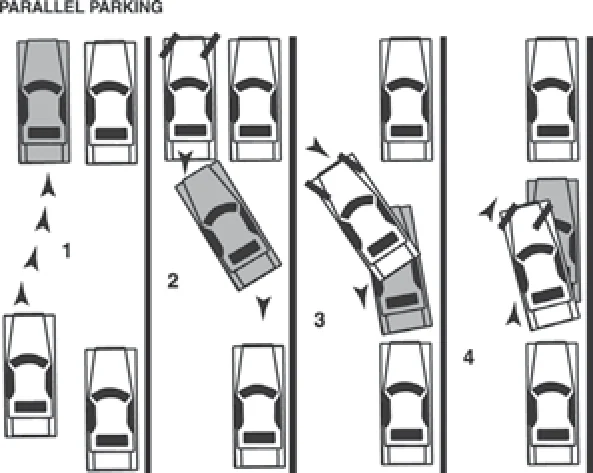
Parallel parking, step by step:

  • Stop even with the vehicle ahead of the space, about 1½ feet to its left
  • Turn the wheels sharply right and back slowly; don't let your front block traffic
  • When clear of the front vehicle, turn the wheels sharply left and keep backing
  • Turn the wheels sharply right and pull forward toward the curb, centered in the space
Handbook p. 38 ↗
Parallel parking steps (1-4)
Parallel parking in four steps

Put it into practice

You park facing uphill on a street with a curb. Turn your wheels to the left, away from the curb, so the tires catch the curb if the car rolls back. Set the parking brake and leave it in park.

Check your understanding

Read the question, decide on an answer, then open it to check the explanation. These are Roadwise study questions based on the source handbook.

When parking on a hill, which direction should you turn your wheels so the vehicle rolls away from traffic if it moves?
  1. Sharply toward the side of the road
  2. Toward the center of the road
  3. Straight ahead
  4. Slightly left, toward traffic

Answer: Sharply toward the side of the road

When you park on a hill, turn your wheels sharply toward the side of the road so a rolling vehicle moves away from traffic.
Handbook p. 37 ↗
Before leaving a vehicle parked on a hill, what should you do with the motor and the gear?
  1. Turn off the motor; leave it in neutral
  2. Leave the motor running in park
  3. Turn off the motor, leave it in proper gear
  4. Leave the motor idling in low gear

Answer: Turn off the motor, leave it in proper gear

Before leaving a parked vehicle on a hill, turn off the motor while leaving the vehicle in the proper gear, and set the parking brake.

Handbook p. 38 ↗
When parallel parking, where should you first stop relative to the vehicle ahead of the space?
  1. Even with it, 3 ft to its left
  2. Behind it, one car length back
  3. Even with it, 1½ ft to its left
  4. Even with it, 5 ft to its left

Answer: Even with it, 1½ ft to its left

You should stop even with the vehicle ahead of the space, about 1½ feet to the left of it, before backing in.

Handbook p. 38 ↗
During parallel parking, which direction do you first turn your wheels when beginning to back into the space?
  1. Sharply to the left
  2. Keep the wheels straight
  3. Turn halfway left
  4. Sharply to the right

Answer: Sharply to the right

Turn your wheels sharply to the right and back slowly into the parking space to begin parallel parking.

Handbook p. 38 ↗
When getting out of a parked vehicle, which side should passengers, especially children, exit from if possible?
  1. The curb side
  2. The traffic side
  3. Either side equally
  4. The side nearest the driver

Answer: The curb side

Always have passengers, especially children, exit the vehicle on the curb side.

Handbook p. 37 ↗
You should always set your parking brake whenever you park your vehicle.
  1. True
  2. False

Answer: True

Always set your parking brake when you park, regardless of terrain.

Handbook p. 37 ↗
Take the lesson checkpoint in the app

More in Parking