roadwise.Open study app

Missouri driving lesson · Highway Driving

Entering and leaving the highway

A 3-minute lesson from the Missouri course. Read the rules and examples, follow the handbook page references, and check your understanding before you move on.

Read time
3 minutes
Course unit
Highway Driving
Checkpoint questions
6
Source pages
41, 42

On a controlled access highway you get on and off only by ramps. Use the whole ramp and acceleration lane to match highway speed, and plan your exit early.

Know the rule

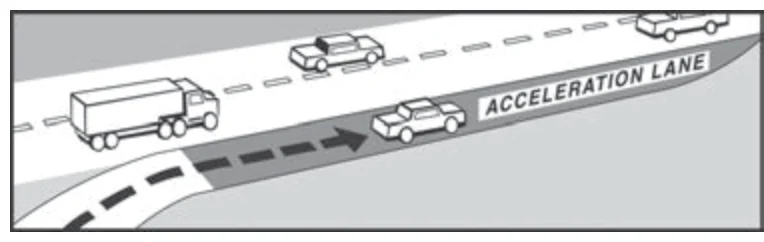
Use the entrance ramp and acceleration lane to speed up to the speed of highway traffic. Watch for an opening, switch on your turn signal and pull smoothly into traffic.

Handbook p. 41 ↗

Know the rule

Don't stop at the end of an acceleration lane unless traffic is very heavy and you have to.

Handbook p. 41 ↗

Know the rule

Drivers on the highway should give you room, but if they don't, don't force your way on. You must yield to them, even if that means stopping at the end of the acceleration lane.

Handbook p. 41 ↗
Acceleration lane merge (highway entry)
Merging from the acceleration lane

Know the rule

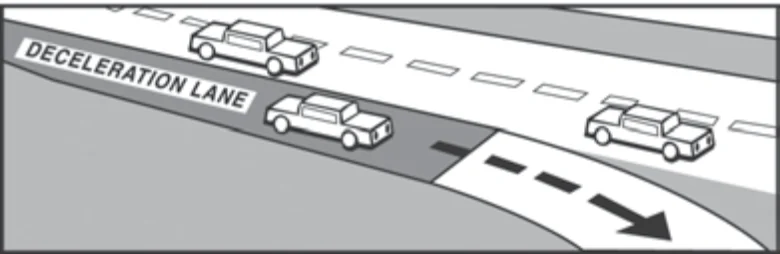
Get into the proper lane well before the deceleration lane. Use the deceleration lane and exit ramp to slow down, obey the ramp's speed advisory sign, and be ready to stop or yield at the end.

Handbook p. 41 ↗
Acceleration lane merge (curved ramp)
Slowing in the deceleration lane

Know the rule

If you miss your exit, don't stop, back up or try to turn around on the highway. Take the next exit and come back.

Handbook p. 41 ↗

Interchange

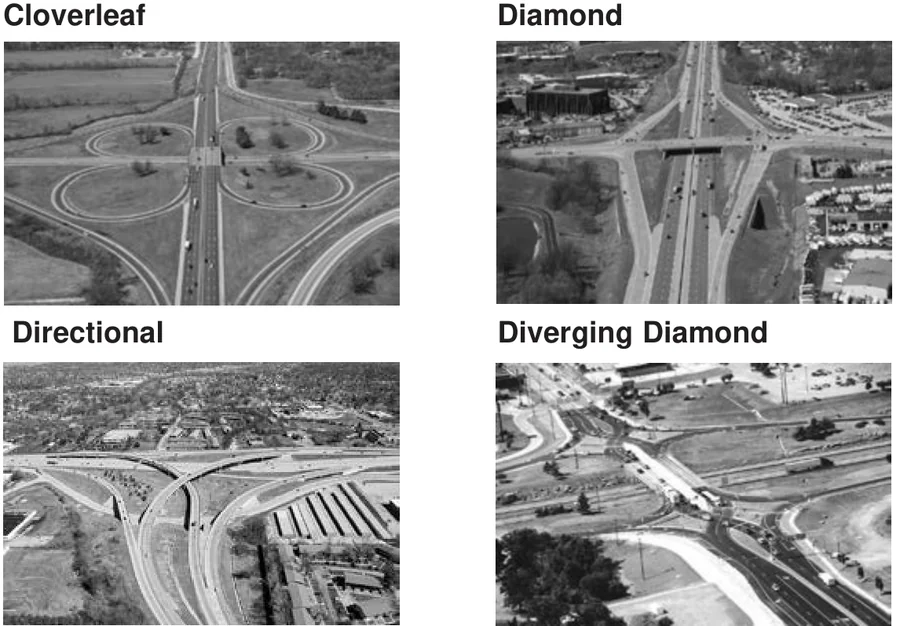
Where two busy highways meet, connected by entrance and exit ramps. Common designs include the cloverleaf, diamond, directional and diverging diamond.

Handbook p. 42 ↗

Diverging Diamond Interchange (DDI)

A newer interchange design used in Missouri where you travel on the left side of the roadway for a short distance. Directional signs show you where to go.

Handbook p. 42 ↗
Interchange design types reference (cloverleaf, diamond, directional, diverging diamond)
Common interchange designs: cloverleaf, diamond, directional and diverging diamond

Put it into practice

You reach the end of the acceleration lane and highway traffic is bumper to bumper with no gap. Don't force your way in. Yield, stopping at the end of the lane if you must, and merge when a gap opens.

Check your understanding

Read the question, decide on an answer, then open it to check the explanation. These are Roadwise study questions based on the source handbook.

What should you use to increase your speed to match highway traffic before merging?
  1. The shoulder
  2. The right lane of the highway
  3. The end of the ramp, from a stop
  4. The ramp and acceleration lane

Answer: The ramp and acceleration lane

Use the ramp and acceleration lane to increase your speed to match highway traffic before merging.
Handbook p. 41 ↗
When entering a highway, who must yield if drivers already on the highway don't make room for you?
  1. Yield to them, even stopping at the ramp
  2. They must always yield to you
  3. The larger vehicle has the right-of-way
  4. Merge anyway once you have signaled

Answer: Yield to them, even stopping at the ramp

Drivers already on the highway should give you room, but if they don't, you must yield to them, even if it means stopping at the ramp's end.

Handbook p. 41 ↗
If you miss your exit on a highway, what should you do?
  1. Stop and back up to the exit
  2. Get off at the next exit
  3. Make a U-turn immediately
  4. Pull onto the shoulder and wait

Answer: Get off at the next exit

If you miss your exit, do not stop, back up, or turn around on the highway; get off at the next exit and come back.

Handbook p. 41 ↗
What lane feature is typically found at the beginning of most exit ramps?
  1. An acceleration lane
  2. A passing lane
  3. A deceleration lane
  4. A center turn lane

Answer: A deceleration lane

At the beginning of most exit ramps is a deceleration lane used to slow down when leaving the highway.

Handbook p. 41 ↗
When entering a highway and traffic is very heavy, is it ever acceptable to stop at the end of an acceleration lane?
  1. No, never under any circumstances
  2. Yes, whenever you feel unsure
  3. No, use the shoulder to merge instead
  4. Yes, if traffic is very heavy

Answer: Yes, if traffic is very heavy

You should not stop at the end of an acceleration lane unless traffic is very heavy and you have to.

Handbook p. 41 ↗
You should be in the proper lane to leave the highway well in advance of the deceleration lane.
  1. True
  2. False

Answer: True

Make sure you are in the proper lane to leave the highway well in advance of the deceleration lane.

Handbook p. 41 ↗
Take the lesson checkpoint in the app

More in Highway Driving