roadwise.Open study app

Iowa driving lesson · Right-of-Way, School Buses & Parking

Stopping for school buses

A 3-minute lesson from the Iowa course. Read the rules and examples, follow the handbook page references, and check your understanding before you move on.

Read time
3 minutes
Course unit
Right-of-Way, School Buses & Parking
Checkpoint questions
6
Source pages
20

School bus rules depend on two things: how many lanes the road has, and whether you're behind the bus or meeting it head-on. Flashing lights warn you a stop is coming; a stopped bus with its stop arm out means children are getting on or off.

A school bus stops with its stop arm out

A school bus stops with its stop arm out
RoadBehind the busMeeting it from the front
2 or 3 lanesStop no closer than 15 ftStop
4 or more lanesStop no closer than 15 ftNo need to stop
Handbook p. 20 ↗

Know the rule

Approaching from the rear (any road): when you see flashing red or amber lights, you may not pass the bus—be prepared to stop. When it stops with its arm extended, stop no closer than 15 feet behind it and stay stopped until the arm retracts and the bus moves again.

Handbook p. 20 ↗
15 ft

Closest you may stop behind a stopped school bus

Handbook p. 20 ↗

Know the rule

Meeting the bus on a 2- or 3-lane road: when amber warning lights flash, slow to no more than 20 mph and be prepared to stop. Stop when the bus stops with its arm extended, and stay stopped until the arm is retracted.

Handbook p. 20 ↗
20 mph

Maximum speed when meeting a school bus flashing amber lights (2- or 3-lane road)

Handbook p. 20 ↗

Know the rule

On a road with four or more lanes, traffic meeting the bus in the opposite lanes need not stop—the only time you may pass a stopped school bus with its stop arm extended.

Handbook p. 20 ↗
180 days

Possible license suspension for violating the school bus law

Handbook p. 20 ↗

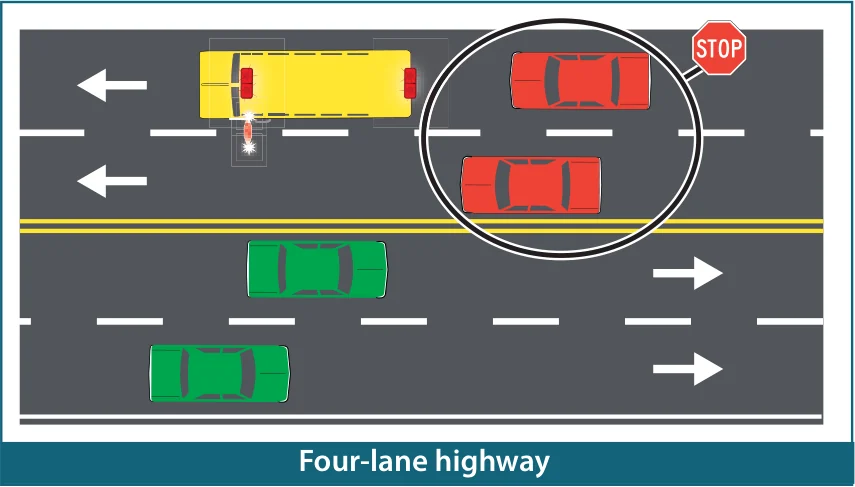
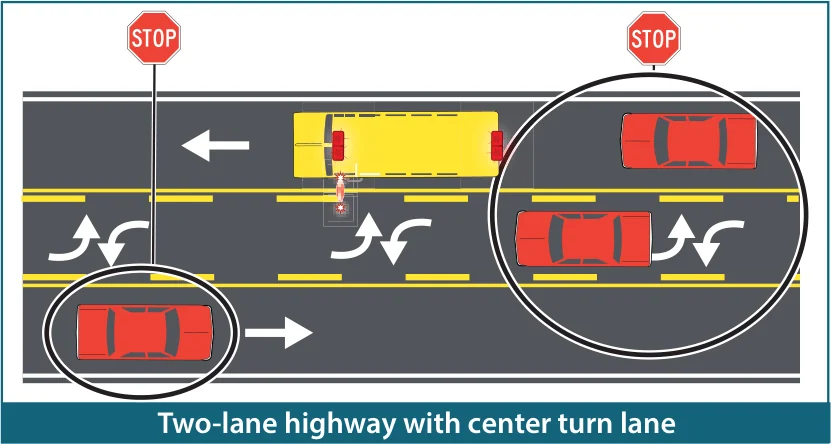
Figure 2.14: who stops?

  • Two-lane highway: all vehicles stop
  • Two-lane highway with center turn lane: all vehicles stop
  • Three-lane highway: all vehicles stop
  • Four-lane highway: only vehicles approaching from the rear stop
  • Four-lane highway with center turn lane: only vehicles approaching from the rear stop
Handbook p. 20 ↗
School bus stop: two-lane highway with center turn lane
Two-lane highway with center turn lane (3 lanes): all vehicles stop
School bus stop: four-lane highway
Four-lane highway: only vehicles approaching from the rear stop

Put it into practice

You're on a two-lane road with a center turn lane, heading toward a bus flashing amber. Slow to 20 mph or less and get ready. When it stops and the arm swings out, stop and wait until the arm is retracted before proceeding with caution.

Check your understanding

Read the question, decide on an answer, then open it to check the explanation. These are Roadwise study questions based on the source handbook.

You are on a two-lane road behind a school bus that stops with its stop arm extended. How close may you stop behind it?
  1. No closer than 15 feet
  2. No closer than 5 feet
  3. No closer than 50 feet
  4. No closer than 10 feet

Answer: No closer than 15 feet

You must stop no closer than 15 feet from the rear of the bus when its stop arm is extended.
Handbook p. 20 ↗
You are driving on a road with four or more lanes and meet a stopped school bus coming from the opposite direction. What should you do?
  1. Stop and wait for the stop arm to retract
  2. Continue on; you don't need to stop
  3. Pass only if you slow to 20 mph
  4. Stop only if children are crossing

Answer: Continue on; you don't need to stop

On a road with four or more lanes, vehicles meeting the bus from the front do not need to stop; this is the only time you may pass a stopped bus.

Handbook p. 20 ↗
Violating Iowa's school bus stop-arm law can result in what consequence?
  1. License suspension for up to one year
  2. License suspension for up to 30 days
  3. Suspension for up to 180 days
  4. A minimum $1,250 fine

Answer: Suspension for up to 180 days

Violating the school bus stop law may result in license suspension for up to 180 days.

Handbook p. 20 ↗
On a two-lane road, meeting a school bus from the front with amber warning lights flashing, what speed must you slow to?
  1. No more than 35 mph
  2. No more than 20 mph
  3. No more than 45 mph
  4. You must stop immediately, not just slow

Answer: No more than 20 mph

When meeting a bus with amber lights flashing on a two- or three-lane road, slow to no more than 20 mph and be prepared to stop.

Handbook p. 20 ↗
A school bus has flashing amber lights but has not yet stopped or extended its arm. What should you do?
  1. Pass immediately before it stops
  2. Only slow down if children are visible
  3. Be ready to stop; don't pass
  4. Continue at normal speed

Answer: Be ready to stop; don't pass

Flashing amber lights warn that the bus is about to stop; you must be ready to stop and not pass.

Handbook p. 20 ↗
You may legally pass a stopped school bus with its stop arm out as long as you slow down to 20 mph first.
  1. True
  2. False

Answer: False

You may never pass a stopped bus with its stop arm extended, except when meeting it from the front on a road with four or more lanes.

Handbook p. 20 ↗
Take the lesson checkpoint in the app

More in Right-of-Way, School Buses & Parking