roadwise.Open study app

Connecticut driving lesson · Right-of-Way, Speed & Parking

Speed limits and stopping distance

A 3-minute lesson from the Connecticut course. Read the rules and examples, follow the handbook page references, and check your understanding before you move on.

Read time
3 minutes
Course unit
Right-of-Way, Speed & Parking
Checkpoint questions
6
Source pages
38

Speed limits are set for ideal conditions. The faster you go, the longer it takes to turn, slow or stop — and stopping distance grows much faster than speed. Drive at a speed that lets you stop within the distance you can see.

Speed limit
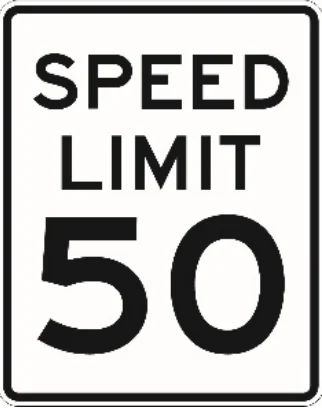
Speed limit sign: the maximum legal speed

Know the rule

Speed limits are based on the road's design and the vehicles that use it, and account for things you can't see, such as side roads, driveways and the amount of traffic.

Handbook p. 38 ↗

Know the rule

Speed limits are posted for ideal conditions. If the road is wet or icy, you can't see well, or traffic is heavy, slow down — you can get a ticket for driving too fast for conditions even at the posted limit.

Handbook p. 38 ↗

Know the rule

The best way to prevent speeding is to know how fast you're going: check the speedometer often. It's easy to go faster than you think, especially after leaving high-speed roads for local roads.

Handbook p. 38 ↗

Know the rule

Stopping at 60 mph doesn't take twice the distance of stopping at 30 mph — it takes over three times the distance.

Handbook p. 38 ↗

Distance to react and stop (dry pavement, good tires and brakes)

Distance to react and stop (dry pavement, good tires and brakes)
SpeedAboutCompare to
50 mph400 feetAbout a city block
30 mph200 feetAlmost half a city block
Handbook p. 38 ↗

Know the rule

If you can't see 400 feet ahead, you may not be driving safely at 50 mph; if you can't see 200 feet ahead, you may not be safe at 30 mph.

Handbook p. 38 ↗

Know the rule

Driving much slower than other traffic can be as bad as speeding: vehicles bunch up and pass you. If cars pile up behind you, pull over when safe and let them pass, or drive faster, or use slower roads.

Handbook p. 38 ↗

Know the rule

Avoid panic stops by seeing events well in advance; slowing or changing lanes may let you avoid stopping. You must come to a complete stop at a stop sign or stop line.

Handbook p. 38 ↗

Put it into practice

It's foggy and you can only see about 200 feet ahead on a 50 mph road. At 50 mph you'd need about 400 feet to stop; even 30 mph takes about 200 feet. Slow down until you can stop within the distance you can see — the posted limit doesn't change that.

Check your understanding

Read the question, decide on an answer, then open it to check the explanation. These are Roadwise study questions based on the source handbook.

About how many feet does it take to stop a vehicle at 50 mph on dry pavement with good tires and brakes?
  1. About 800 feet
  2. About 200 feet
  3. About 100 feet
  4. About 400 feet

Answer: About 400 feet

At 50 mph, it can take about 400 feet to react and bring your vehicle to a stop.
Handbook p. 38 ↗
About how many feet does it take to stop a vehicle at 30 mph on dry pavement with good tires and brakes?
  1. About 400 feet
  2. About 600 feet
  3. About 200 feet
  4. About 50 feet

Answer: About 200 feet

At 30 mph, it can take about 200 feet to stop, almost half a city block.

Handbook p. 38 ↗
Does doubling your speed from 30 to 60 mph double your stopping distance?
  1. Yes, it roughly doubles
  2. No, it takes over three times as far
  3. No, it takes about 1.5 times as far
  4. No, it takes about ten times as far

Answer: No, it takes over three times as far

Stopping at 60 mph does not take twice the distance it takes at 30 mph, but over three times the distance.

Handbook p. 38 ↗
Even if you are driving at the posted speed limit, when could you still get a ticket for speed?
  1. If you're too fast for road conditions
  2. Only in a school or work zone
  3. Only when towing a trailer
  4. Never; the posted limit is always legal

Answer: If you're too fast for road conditions

Even at the posted speed limit, you can get a ticket for traveling too fast for road conditions.

Handbook p. 38 ↗
Why can driving much slower than surrounding traffic be dangerous?
  1. Slow driving is always the safest choice
  2. It increases your stopping distance
  3. It causes bunching and risky passing
  4. It only matters on highways

Answer: It causes bunching and risky passing

Driving much slower than other traffic can cause vehicles to bunch up behind you, causing other traffic to pass.

Handbook p. 38 ↗
According to the handbook, what is the best way to prevent speeding?
  1. Watch the speed of cars around you
  2. Check your speedometer often
  3. Rely on your sense of speed
  4. Use cruise control on local roads

Answer: Check your speedometer often

The best way to prevent speeding is to know how fast you are going; check the speedometer often.

Handbook p. 38 ↗
Take the lesson checkpoint in the app

More in Right-of-Way, Speed & Parking