roadwise.Open study app

Colorado driving lesson · Aggressive Driving & Emergencies

After a crash, Move Over & first aid

A 4-minute lesson from the Colorado course. Read the rules and examples, follow the handbook page references, and check your understanding before you move on.

Read time
4 minutes
Course unit
Aggressive Driving & Emergencies
Checkpoint questions
6
Source pages
29, 30

What you do after a crash matters legally and for everyone's safety. Colorado sets clear duties to stop, help, report and share information, and two laws, Move It and Move Over, keep traffic and responders safe.

Know the rule

If you're in a crash, you must provide proof of insurance to law enforcement at the scene or at the police station.

Handbook p. 29 ↗

After a crash:

  • Stop immediately; never leave the scene
  • Check for injuries and give reasonable help where practical
  • Call law enforcement and emergency personnel
  • Exchange names, addresses, phone numbers, registration and insurance information
Handbook p. 29 ↗

Know the rule

If the driver is physically unable to report a crash with injuries, a passenger must report it and, if directed, stay at the scene until law enforcement arrives.

Handbook p. 29 ↗

Accident Alert Status

Times when weather is so severe that law enforcement can't respond to the large number of crashes.

Handbook p. 29 ↗

Know the rule

Under Accident Alert Status, with no alcohol or drugs, no injuries and all vehicles drivable, exchange information and file a report with law enforcement within 24 hours.

Handbook p. 29 ↗

Know the rule

If you hit a parked car and can't find the owner, call law enforcement and leave a note where the owner will find it.

Handbook p. 29 ↗

Move It Law: after a minor crash on a divided highway, move your vehicles off the highway when:

  • The vehicle is drivable
  • No drugs or alcohol are involved
  • There are no injuries
Handbook p. 29 ↗

Know the rule

Once safe, notify law enforcement and exchange information. Police and insurers won't penalize you for moving your car.

Handbook p. 29 ↗
Move Over Law
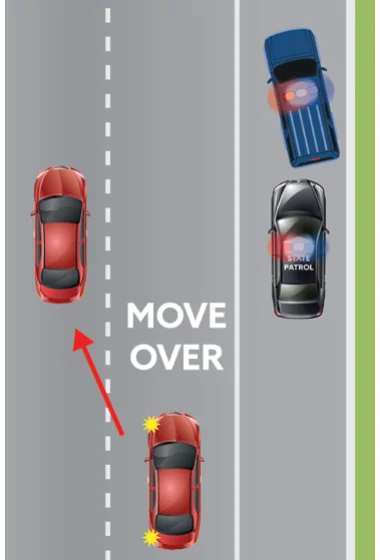
Move Over: change lanes away from a stopped vehicle

Know the rule

Move Over Law: for any stationary vehicle on a highway with hazards flashing, move over one lane if safe. If not, or on a road with one lane each way, slow to at least 20 mph below the posted limit.

Handbook p. 30 ↗

Know the rule

The Move Over Law protects law enforcement, fire, maintenance, other emergency personnel, tow truck drivers and you.

Handbook p. 30 ↗

Know the rule

Good Samaritan laws protect rescuers from being sued when they act as a reasonable, prudent person would, using common sense and not exceeding their training.

Handbook p. 30 ↗

A reasonable and prudent rescuer would:

  • Move a victim only if their life is in danger
  • Ask a conscious victim for permission before giving care
  • Check for life-threatening emergencies before other care
  • Call for professional help and keep caring until trained personnel arrive
Handbook p. 30 ↗

Put it into practice

During a blizzard declared an Accident Alert, you slide into another car. No one is hurt, nobody has been drinking and both cars run. Exchange information, then file an accident report with law enforcement within 24 hours.

Check your understanding

Read the question, decide on an answer, then open it to check the explanation. These are Roadwise study questions based on the source handbook.

After a crash, what must you provide to law enforcement at the scene?
  1. Proof of insurance
  2. A full written statement of fault
  3. Your vehicle title
  4. A copy of your license history

Answer: Proof of insurance

You must provide proof of insurance to law enforcement at the scene of a crash, or at the police station.
Handbook p. 29 ↗
Under Colorado's 'Move It Law,' when must drivers move their vehicles off a divided highway after a minor crash?
  1. When it's drivable, no one is hurt, and no drugs or alcohol
  2. Only after an officer arrives
  3. Only if law enforcement orders it
  4. Never; vehicles must stay in place until police arrive

Answer: When it's drivable, no one is hurt, and no drugs or alcohol

The Move It Law requires drivers to move a drivable, injury-free, non-impaired crash off a divided highway and exchange info at a safe location.

Handbook p. 29 ↗
Under Colorado's Move Over Law, what should you do when you see a stationary vehicle with hazards flashing on the highway, if it's safe?
  1. Flash your headlights and continue at the same speed
  2. Stop directly behind it
  3. Move over one lane
  4. Pull directly alongside it

Answer: Move over one lane

The Move Over Law requires you to move over one lane if you can do so safely when passing a stationary vehicle with hazards flashing.

Handbook p. 30 ↗
If you cannot safely move over for a stationary vehicle with hazards flashing on a one-lane-per-direction road, what must you do instead?
  1. Slow down to at least 20 mph below the posted speed limit
  2. Maintain the posted speed limit
  3. Stop completely in your lane
  4. Slow down by about 5 mph

Answer: Slow down to at least 20 mph below the posted speed limit

If you can't move over safely, or the road is one lane in each direction, slow to at least 20 mph below the posted speed limit.

Handbook p. 30 ↗
Under Colorado's Good Samaritan protections, when should you move a crash victim?
  1. Only if you are a medical professional
  2. Never, under any circumstance
  3. Always, to get them away from traffic
  4. Only if the victim's life is in danger

Answer: Only if the victim's life is in danger

A reasonable and prudent person would move a victim only if their life is in danger, per Good Samaritan guidance.

Handbook p. 30 ↗
Under 'Accident Alert Status' with no injuries, drugs, or alcohol involved and all vehicles still drivable, what must you do within 24 hours?
  1. Notify your insurer only
  2. File an accident report with law enforcement
  3. Get a vehicle safety inspection
  4. Nothing further is required

Answer: File an accident report with law enforcement

Under Accident Alert Status, after exchanging information you must file an accident report with law enforcement within 24 hours.

Handbook p. 29 ↗
Take the lesson checkpoint in the app

More in Aggressive Driving & Emergencies