roadwise.Open study app

Arkansas driving lesson · Emergencies & Crashes

Avoiding collisions & handling skids

A 3-minute lesson from the Arkansas course. Read the rules and examples, follow the handbook page references, and check your understanding before you move on.

Read time
3 minutes
Course unit
Emergencies & Crashes
Checkpoint questions
6
Source pages
90, 91

When a crash looks likely, many drivers freeze or do something that doesn't help. You have three options: stop, turn, or speed up. How you brake and steer depends on whether your car has antilock brakes (ABS).

Three ways to avoid a collision:

  • Stop
  • Turn
  • Speed up
Handbook p. 90 ↗

Stopping fast

Stopping fast
BrakesWhat to do
With ABSPress as hard as you can and keep pressing
Without ABSBrake hard without locking the wheels
Handbook p. 90 ↗

Know the rule

With ABS you may feel the pedal push back; don't let up. ABS only works while the pedal is pushed down.

Handbook p. 90 ↗

Know the rule

Without ABS, if the brakes lock and you feel a skid, quickly let up on the pedal; as soon as the skid stops, push down again. Repeat until you stop.

Handbook p. 90 ↗

Know the rule

In most cases you can turn quicker than you can stop, so consider turning to avoid a collision. Grip the wheel with both hands at 10 and 2 o'clock, and be ready to keep control after swerving.

Handbook p. 90 ↗

Know the rule

With ABS you can steer while braking without skidding. Without ABS, brake, then let up and turn the wheel; don't lock the front wheels or turn so sharply the car just plows ahead.

Handbook p. 90 ↗

Know the rule

Generally, it is better to run off the road than to crash head-on into another vehicle.

Handbook p. 90 ↗

Know the rule

Speed up to escape when another vehicle is about to hit you from the side or behind and there's room ahead. Slow down once the danger has passed.

Handbook p. 90 ↗

Know the rule

Driving too fast for conditions causes the vast majority of skids, and high speed makes a skid more likely if you turn or stop suddenly.

Handbook p. 91 ↗

If your vehicle skids:

  • Stay off the brake; braking can make the skid worse
  • Steer in the direction you want the vehicle to go
  • As it straightens out, turn the wheel back the other way, or a new skid may start
  • Keep correcting left and right until you regain control
Handbook p. 91 ↗
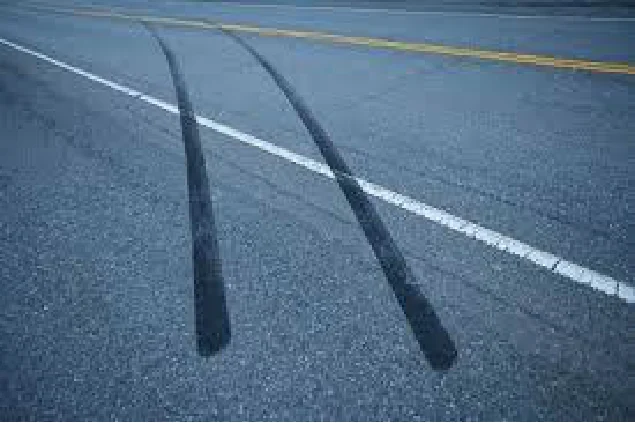
Skid marks
Skid marks on the pavement

Put it into practice

Your rear end slides right on a wet curve. Take your foot off the brake and steer where you want the car to go. As it straightens, turn the wheel back so the car doesn't swing the other way.

Check your understanding

Read the question, decide on an answer, then open it to check the explanation. These are Roadwise study questions based on the source handbook.

When trying to avoid a collision, what three options does the handbook describe?
  1. Brake, honk, and swerve
  2. Stop, reverse, or flash lights
  3. Brake, signal, and coast
  4. Stop, turn, or speed up

Answer: Stop, turn, or speed up

In avoiding a collision, drivers have three options: stop, turn, or speed up.
Handbook p. 90 ↗
With ABS (antilock brakes), how should you brake to stop quickly?
  1. Press hard and keep pressing on the brake pedal
  2. Pump the brake pedal rapidly
  3. Press and release repeatedly
  4. Press lightly and steer carefully around the hazard

Answer: Press hard and keep pressing on the brake pedal

With ABS, press the brake pedal as hard as you can and keep pressing; the system prevents skidding.

Handbook p. 90 ↗
Without ABS, what should you do if your brakes lock up and the vehicle starts to skid?
  1. Press down even harder
  2. Quickly let up on the brake pedal
  3. Turn the wheel sharply while braking
  4. Pull the parking brake instead

Answer: Quickly let up on the brake pedal

Without ABS, letting up on the brake pedal as soon as the wheels lock helps you regain control.

Handbook p. 90 ↗
What is generally true about a vehicle's ability to turn versus stop to avoid a collision?
  1. A vehicle can always stop faster than it can turn
  2. Turning and stopping take the same distance
  3. In most cases, a vehicle can turn quicker than it can be stopped
  4. Turning takes about twice the distance of stopping

Answer: In most cases, a vehicle can turn quicker than it can be stopped

The handbook notes that in most cases a driver can turn the vehicle quicker than it can be stopped.

Handbook p. 90 ↗
If your vehicle begins to skid, what should you avoid doing?
  1. Hitting the brakes
  2. Steering in the direction you want to go
  3. Continuing to correct your steering
  4. Turning the wheel back as the car straightens

Answer: Hitting the brakes

Braking during a skid can make the vehicle skid more, since the tires have lost their grip.

Handbook p. 91 ↗
What is the most common cause of skids?
  1. Worn tire tread
  2. Using cruise control
  3. Driving too fast for the road conditions
  4. Oil on the road after rain

Answer: Driving too fast for the road conditions

The vast majority of skids happen because a driver is traveling too fast for the conditions.

Handbook p. 91 ↗
Take the lesson checkpoint in the app

More in Emergencies & Crashes