roadwise.Open study app

Alaska driving lesson · Passing & No-Passing Zones

When you may not pass

A 3-minute lesson from the Alaska course. Read the rules and examples, follow the handbook page references, and check your understanding before you move on.

Read time
3 minutes
Course unit
Passing & No-Passing Zones
Checkpoint questions
6
Source pages
42, 60, 61

Most no-passing rules exist because you can't see far enough ahead, or because someone may suddenly be in your path. Learn the list, including the exact 100-foot distances.

Situations where passing is not allowed
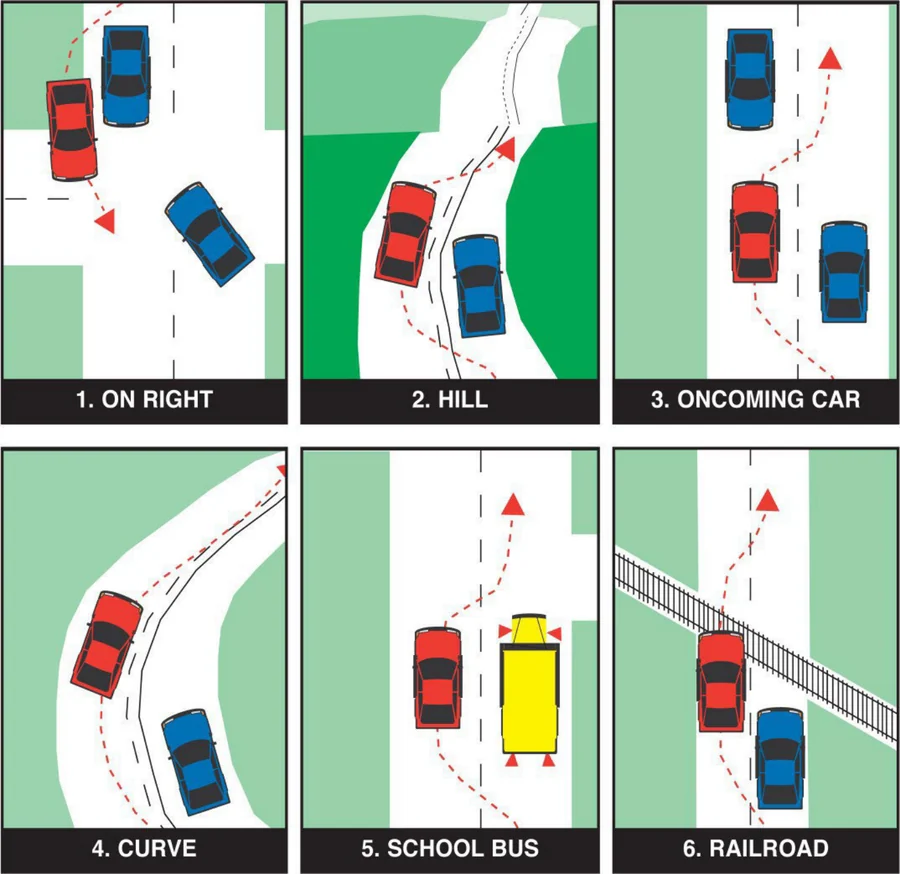
No-passing situations: on the right, hills, oncoming cars, curves, school buses, railroads

Do not pass:

  • On the right shoulder of the highway (13 AAC 02.055)
  • Approaching a hill or curve without a sufficient clear view ahead
  • Unless you can finish without endangering oncoming traffic and before a solid yellow line in your lane
  • When a solid yellow line is in your lane
  • A school bus with red lights flashing and stop arm out, on an undivided road or the same divided travel way
  • Within 100 feet of, or while crossing, an intersection or railroad crossing
  • Within 100 feet of a posted narrow bridge, viaduct, or tunnel
Handbook p. 42 ↗
100 feet

No passing when approaching within this distance of an intersection, railroad crossing, or posted narrow bridge, viaduct or tunnel

Handbook p. 42 ↗

Know the rule

Center lanes are reserved for slowing down before a left turn. You may not use a center lane for passing.

Handbook p. 42 ↗

Know the rule

A two-way left turn lane may not be used as a driving, accelerating, or passing lane.

Handbook p. 60 ↗

Know the rule

The end of a "no passing zone" doesn't mean it's safe to pass; it only means you can see farther ahead.

Handbook p. 42 ↗

Know the rule

Solid yellow center lines mean passing is not permitted, although you may cross them to turn into a driveway.

Handbook p. 61 ↗

Put it into practice

On a two-lane road you're 80 feet from an intersection behind a slow tractor. Even with a dashed line and no oncoming traffic, you may not pass within 100 feet of an intersection. Wait until you're through it.

Check your understanding

Read the question, decide on an answer, then open it to check the explanation. These are Roadwise study questions based on the source handbook.

Where is passing always prohibited on a highway?
  1. The right shoulder
  2. In the left lane of a two-lane road
  3. On a straight, level road
  4. On a road with a dashed yellow center line

Answer: The right shoulder

Passing on the right shoulder of the highway is prohibited.
Handbook p. 42 ↗
When approaching a hill or curve, when is passing prohibited?
  1. Only if another car is oncoming and visible
  2. When there isn't a clear view ahead
  3. Only after sunset
  4. Only when towing a trailer

Answer: When there isn't a clear view ahead

You may not pass approaching a hill or curve without sufficient clear view ahead.

Handbook p. 42 ↗
Within how many feet of an intersection or railroad crossing is passing prohibited?
  1. 50 feet
  2. 200 feet
  3. 100 feet
  4. 300 feet

Answer: 100 feet

Passing is prohibited within 100 feet of an intersection or railroad crossing.

Handbook p. 42 ↗
Within how many feet of a posted narrow bridge, viaduct, or tunnel is passing prohibited?
  1. 50 feet
  2. 200 feet
  3. 25 feet
  4. 100 feet

Answer: 100 feet

Passing is prohibited within 100 feet of a posted narrow bridge, viaduct, or tunnel.

Handbook p. 42 ↗
Can you use a center turn lane to pass another vehicle?
  1. Yes, as long as you signal first
  2. Yes, but only for less than 200 feet
  3. No, it is reserved for decelerating to turn left
  4. Yes, if traffic is light

Answer: No, it is reserved for decelerating to turn left

Center lanes are reserved for decelerating in advance of a left turn, not for passing.

Handbook p. 42 ↗
What does the end of a 'no passing zone' actually mean?
  1. Passing is now always safe to attempt
  2. The speed limit increases immediately
  3. You must pass within the next 500 feet
  4. There is increased visibility ahead, not that passing is automatically safe

Answer: There is increased visibility ahead, not that passing is automatically safe

The end of a no-passing zone means there is increased visibility, not a guarantee of safety.

Handbook p. 42 ↗
Take the lesson checkpoint in the app

More in Passing & No-Passing Zones